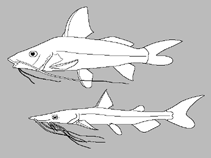
Clasificación / Nombres
Nombres comunes | Sinónimos | Catalog of Fishes(Género, Especie) | ITIS | CoL | WoRMS | Cloffa
>
Siluriformes (Catfishes) >
Pimelodidae (Long-whiskered catfishes)
Etymology: Pimelodus: Greek, pimele = fat + Greek, odous = teeth (Ref. 45335); halisodous: Derived from the Greek adjective 'halis', meaning in crowds, in plenty, sufficient, enough, and the Greek noun 'odous', meaning tooth, in reference to the several irregular rows of conical and slender teeth on each premaxilla.
Entorno: milieu / zona climática / rango de profundidad / gama de distribución
Ecología
; agua dulce demersal. Tropical
South America: Rio Tocantins drainage in Brazil.
Tamaño / Peso / Edad
Madurez: Lm ? range ? - ? cm
Max length : 11.1 cm SL macho / no sexado; (Ref. 79502)
Descripción breve
Claves de identificación | Morfología | Morfometría
Espinas dorsales (total) : 2; Radios blandos dorsales (total) : 7; Vértebra: 41. Differs from all other species of the genus, except Pimelodus jivaro, Pimelodus joannis, Pimelodus ornatus, Pimelodus pictus, and Pimelodus stewarti, by the possession of a dorsal median crest along supraoccipital process; and shorter
distance between the posterior nostril and the anterior orbital border (posterior nostril closer to anterior orbital border). Can be separated from Pimelodus jivaro by the shorter maxillary barbel, extending only slightly beyond caudal-fin base (vs. maxillary barbel surpassing total length); from Pimelodus ornatus and Pimelodus pictus by its
uniform grayish to yellowish coloration (vs. presence of two bands or dark dots along flanks, respectively); from Pimelodus stewarti and Pimelodus joannis by its longer pectoral-fin spine (20.0-23.5 vs. 15.4-19.6% SL); longer snout (43.1-47.9 vs. 35.8-41.8% HL); and larger number of premaxillary tooth rows (13-16 vs. 5-9) (Ref. 79502).
Ciclo vital y comportamiento de apareamiento
Madurez | Reproducción | Puesta | Huevos | Fecundidad | Larva
Ribeiro, F.R.V., C.A.S. Lucena and P.H.F. Lucinda, 2008. Three new Pimelodus species (Siluriformes: Pimelodidae) from the rio Tocantins drainage, Brazil. Neotrop. Ichthyol. 6(3):455-464. (Ref. 79502)
Situación en la Lista Roja de la UICN (Ref. 130435: Version 2025-2 (Global))
Amenaza para el ser humano
Harmless
Usos humanos
Herramientas
Informes especiales
Descargar XML
Fuentes de Internet
Estimaciones basadas en modelos
Índice de diversidad filogenética (Referencia
82804): PD
50 = 0.5000 [Uniqueness, from 0.5 = low to 2.0 = high].
Bayesian length-weight: a=0.00692 (0.00304 - 0.01573), b=3.10 (2.92 - 3.28), in cm total length, based on LWR estimates for this Genus-body shape (Ref.
93245).
Nivel trófico (Referencia
69278): 3.2 ±0.5 se; based on size and trophs of closest relatives
Resiliencia (Referencia
120179): Alto, población duplicada en un tiempo mínimo inferior a 15 meses (Preliminary K or Fecundity.).
Vulnerabilidad pesquera (Ref.
59153): Low vulnerability (10 of 100).
🛈