>
Characiformes (Characins) >
Alestidae (African tetras)
Etymology: Bryconaethiops: Greek, bryko = to bite+ Aethiops, region in North east Africa (Ref. 45335); yseuxi: Named after Dr. E. Yseux, professor at the Université Libre de Bruxelles (Ref. 74421).
Eponymy: Dr Émile Ghislain Joseph Yseux (1835–1915) was a professor of zoology at the Université Libre de Bruxelles, Belgium. He was also a physician and a founding member of the Royal Society of Public Medicine and Medical Topography of Belgium. (Ref. 128868), visit book page.
More on author: Boulenger.
Milieu: milieu / Klimaatzone / Diepte / verspreidingsgebied
Ecologie
; zoet water pelagisch. Tropical
Africa: from Boma on the lower Congo River up to Pool Malebo, in Republic of Congo and Democratic Republic of the Congo basin (Ref. 74421).
Grootte / Gewicht / Leeftijd
Maturiteit: Lm ? range ? - ? cm
Max length : 7.2 cm SL mannelijk / geslacht onbekend; (Ref. 74421)
Korte beschrijving
Determinatiesleutels | Morfologie | Morfometrie
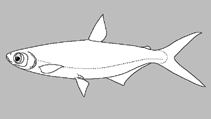
Dorsale stekels (totaal) : 0; Dorsale zachte stralen (totaal) : 10; Anale stekels: 0; Anale zachte stralen: 21 - 23. Bryconaethiops yseuxi can be distinguished from all other known Bryconaethiops species based on the following unique combination of characters: a high number of scale rows between anterior origin of dorsal fin and lateral line (7.5 vs. 6.5 or less); a low number of gill rakers on the first gill arch; and a long dorsal-fin and anal-fin bases, respectively 15.7-17.6% and 22.7-25.9% of standard length (Ref. 74421). Body deep and somewhat laterally compressed (Ref. 74421). Mouth terminal; upper jaw with three rows of premaxillary teeth; external row composed of two small median teeth with a small lateral cusp at their outer side; a median row with 6 or 7 teeth; and an inner row of 8 pluricuspid teeth with their cusp on a median row and without an anterior cusp or row of cusps as generally found in the other Bryconaethiops species (Ref. 74421). Lower jaw with an external series of 6 large pluricuspid teeth and an inner row of two median caniniform teeth (Ref. 74421). Lateral line scales 34-39; longitudinal line scales 36-40 (Ref. 74421). Head and body of live mature male specimens silvery with a pinkish hue on sides of the body; upper side of head green-olive; humeral spot present but not well marked; adipose-fin whitish transparent, blackish at base (Ref. 74421). After preservation, body yellowish white; darker above lateral line with scales above lateral line faintly dark brown on their basal part; fins whitish, transparent in overall appearance; humeral spot not well distinguishable, or even regularly absent (Ref. 74421).
Body shape (shape guide): fusiform / normal.
Levenscyclus en paargedrag
Maturiteit | Voortplanting | Paaien | Eieren | Fecunditeit | Larven
Ibala Zamba, A., G. De Boeck, V. Mamonekene and E. Vreven, 2007. Rehabilitation of Bryconaethiops yseuxi Boulenger, 1899 (Characiformes: Alestidae) from the Congo River basin, Africa. J. Nat. Hist. 41(17-20):1213-1226. (Ref. 74421)
Status op de Rode Lijst van het IUCN (Ref. 130435: Version 2025-2 (Global))
Gevaar voor de mens
Harmless
Gebruik door de mens
Tools
Speciale rapporten
Download XML
Internetbronnen
Schattingen op basis van modellen
Fylogenetische diversiteitsindex (Ref.
82804): PD
50 = 0.5312 [Uniqueness, from 0.5 = low to 2.0 = high].
Bayesian length-weight: a=0.01072 (0.00491 - 0.02339), b=3.02 (2.84 - 3.20), in cm total length, based on LWR estimates for this (Sub)family-body shape (Ref.
93245).
Trofisch niveau (Ref.
69278): 3.1 ±0.4 se; based on size and trophs of closest relatives
Weerstandsvermogen (Ref.
120179): Hoog, minimale populatieverdubbelingstijd minder dan 15 maanden (Preliminary K or Fecundity.).
Kwetsbaarheid van de visserij (Ref.
59153): Low vulnerability (10 of 100).
🛈