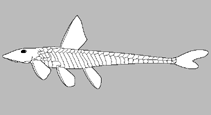
Classificatie / Namen
Lokale namen | Synoniemen | Catalog of Fishes(Genus, Soort(en)) | ITIS | CoL | WoRMS | Cloffa
>
Siluriformes (Catfishes) >
Loricariidae (Armored catfishes) > Hypostominae
Etymology: Pseudancistrus: Greek, pseudes = false + Greek, agkistron = hook (Ref. 45335); corantijniensis: The name is derived from the Corantijn River, to which this species seems to be restricted.
Milieu: milieu / Klimaatzone / Diepte / verspreidingsgebied
Ecologie
; zoet water benthopelagisch. Tropical; 5°N - 4°N, 57°W - 58°W
South America: Suriname. Known from middle and lower Corantijn River.
Grootte / Gewicht / Leeftijd
Maturiteit: Lm ? range ? - ? cm
Max length : 17.9 cm SL mannelijk / geslacht onbekend; (Ref. 79572)
Korte beschrijving
Determinatiesleutels | Morfologie | Morfometrie
Dorsale stekels (totaal) : 1; Dorsale zachte stralen (totaal) : 7; Anale stekels: 1; Anale zachte stralen: 4. Pseudancistrus corantijniensis is distinguished from non-derived Pseudancistrus and other Ancistrini by the presence of hypertrophied odontodes along the snout in males as well as in females and quite
early in ontogeny. Pseudancistrus corantijniensis is diagnosed from derived Pseudancistrus on the basis of coloration: whitish spots very small, crowded and faint (especially in preserved specimens) on the snout to the posterior border of the eyes and the anterior border of the cleithrum, becoming abruptly larger (at least 1 mm in diameter even in young specimens), more spaced and more visible on the posterior part of the head. Large whitish spots continue along the body with a slight and gradual increase in size posteriorly. A single large whitish spot is generally present on each dorso-lateral plate posterior to the pelvic-fins. Pseudancistrus barbatus and P. depressus have smaller whitish spots covering the body and the spots increase slightly
and gradually in size from snout to caudal peduncle rather than displaying an abrupt spot size reduction posterior to the eyes as in P. corantijniensis. In P. nigrescens, the whitish spots increase gradually in size from the
snout to caudal peduncle, yet they become bigger and hazier than in the other derived Pseudancistrus. In the latter species, larger spots are often not round and can cover more than one plate.
Body shape (shape guide): elongated; Cross section: compressed.
Facultative air-breathing in the genus (Ref. 126274)
Levenscyclus en paargedrag
Maturiteit | Voortplanting | Paaien | Eieren | Fecunditeit | Larven
De Chambrier, S. and J.I. Montoya-Burgos, 2008. Pseudancistrus corantijniensis, a new species from the Guyana Shield (Siluriformes: Loricariidae) with a molecular and morphological description of the Pseudancistrus barbatus group. Zootaxa 1918:45-58. (Ref. 79572)
Status op de Rode Lijst van het IUCN (Ref. 130435: Version 2025-2 (Global))
Gevaar voor de mens
Harmless
Gebruik door de mens
Tools
Speciale rapporten
Download XML
Internetbronnen
Schattingen op basis van modellen
Fylogenetische diversiteitsindex (Ref.
82804): PD
50 = 0.5000 [Uniqueness, from 0.5 = low to 2.0 = high].
Bayesian length-weight: a=0.01549 (0.00726 - 0.03306), b=2.96 (2.79 - 3.13), in cm total length, based on LWR estimates for this (Sub)family-body shape (Ref.
93245).
Weerstandsvermogen (Ref.
120179): Gemiddeld, minimale populatieverdubbelingstijd 1,4-4,4 jaar (Preliminary K or Fecundity.).
Kwetsbaarheid van de visserij (Ref.
59153): Low vulnerability (12 of 100).
🛈