Klassifizierung / Names
Namen | Synonyme | Catalog of Fishes(Gattung, Arten) | ITIS | CoL | WoRMS | Cloffa
>
Gobiiformes (Gobies) >
Gobiidae (Gobies) > Gobiinae
Etymology: Peter: The generic name Peter refers to the first name of two outstanding goby enthusiasts: Peter J. Miller, the British goby systematicist and Peter Wirtz, the German naturalist and biologist; wirtzi: Named for Peter Wirtz, Madeira, who collected all specimens of both new Didogobius species described herein as well as numerous additional gobies from the tropical and temperate eastern Atlantic Ocean now housed
in ZSM.
Eponymy: Dr Peter Wirtz (d: 1948) is an independent researcher of marine biology, a blenny taxonomist and an underwater photographer. [...] (Ref. 128868), visit book page.
Umwelt: Milieu / Klimazone / Tiefenbereich / Verbreitungsgebiet
Ökologie
seewasser benthopelagisch; tiefenbereich 15 - 25 m (Ref. 79573). Tropical; 16°N - 15°N
North Atlantic Ocean: Cape Verde Islands (Ref. 79573).
Größe / Gewicht / Alter
Geschlechtsreife: Lm ? range ? - ? cm
Max length : 3.1 cm SL Männchen/unbestimmt; (Ref. 79573)
Kurzbeschreibung
Bestimmungsschlüssel | Morphologie | Morphometrie
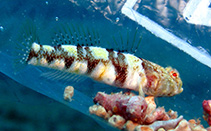
This species is distinguished from its congeners on having an anterior nostril that is barely reaching, not overlapping the upper lip; posterior nostril slightly erected and not tubular; with row 1 below eye; dorsal end of suborbital rows 2 and 3 are distant from the orbit; the suborbital row 7 consists of more than one papilla; suborbital row b anteriorly and not extending to below eye; anterior dorsal row m consists of more than one papilla; the body is not elongated (body depth at the pelvic fin origin/SL about 1/5). It differs from all other Didogobius except
D. splechtnai and D. amicuscaridis by having a head that is not strongly depressed and pectoral fin reaching vertical of second dorsal. It differs from D. splechtnai with first dorsal fin spine not being the longest one in the first dorsal fin (D1) and by a flat predorsal profile; with D. amicuscaridis it differs most from D. bentuvii in having preopercular canals; anterior oculoscapular canal with pores ?, ?, ?, ?, ?, ?, ?; with normal eyes, not reduced; narrow interorbit which is much narrower than eye diameter; rounded caudal and not elongated; anterior dorsal rows o connected; anterior dorsal row g ends anteriorly in front row o; it differs from another similar, but yet undescribed, species of
Didogobius (or a possibly a closely related new genus) from the Canary islands by possessing anterior oculoscapular and preopercular canals and pores (Van Tassell, pers.comm.); differs from D. amicuscaridis in having 48-51 longitudinal lateral line scales (vs. LL 37); 15-16 transverse scale series (vs. 12-14); 18 pectoral fin rays (vs. 17); a shorter head, 25.9-27.4 % SL (vs. 31.7 %); much less compressed caudal part of flanc, body width at anal fin origin 13.1-13.2 % SL (vs. 8.6 % SL); and with first dorsal fin spines shorter than in D. amicuscaridis: D1 I/SL = 12-13 %, D1 II/SL = 14-16 %, D1 III/SL = 13-15 % vs. D1 I/SL = 16 %, D1 II/SL = 22 %, D1 III/SL = 19 %; 3-6 posterior flanc bars in zigzag pattern, with pale area in between separated in upper and lower blotches vs. 3-6 posterior flanc bars straight vertical with pale bars in between uninterrupted from dorsal to lateral midline; preserved specimens' basal part of pectoral fin base and of pectoral fin membrane whitish vs. pectoral fin base pigmented, with dark dot in upper part (Ref. 79573).
Body shape (shape guide): fusiform / normal.
Only single specimens were observed at the entrance of burrows of the axiid shrimp, Axiopsis serratifrons; at 16 m depth over coarse sand (Ref. 79573).
Lebenszyklus und Paarungsverhalten
Geschlechtsreife | Fortpflanzung | Ablaichen | Eier | Fruchtbarkeit | Larven
Schliewen, U.K. and M. Kovačić, 2008. Didogobius amicuscaridis spec. nov. and D. wirtzi spec. nov., two new species of symbiotic gobiid fish from São Tomé and Cape Verde islands. Spixiana 31(2):247-261. (Ref. 79573)
IUCN Rote Liste Status (Ref. 130435: Version 2025-2 (Global))
Bedrohung für Menschen
Harmless
Nutzung durch Menschen
Tools
Zusatzinformationen
Download XML
Internet Quellen
Schätzungen auf der Grundlage von Modellen
Phylogenetischer Diversitätsindex (Ref.
82804): PD
50 = 0.7500 [Uniqueness, from 0.5 = low to 2.0 = high].
Bayesian length-weight: a=0.01023 (0.00477 - 0.02194), b=3.01 (2.83 - 3.19), in cm total length, based on LWR estimates for this (Sub)family-body shape (Ref.
93245).
Trophische Ebene (Ref.
69278): 3.1 ±0.3 se; based on size and trophs of closest relatives
Widerstandsfähigkeit (Ref.
120179): hoch, Verdopplung der Population dauert weniger als 15 Monate. (Preliminary K or Fecundity.).
Anfälligkeit der Fischerei (Ref.
59153): Low vulnerability (10 of 100).
🛈