>
Ovalentaria/misc (Various families in series Ovalentaria) >
Opistognathidae (Jawfishes)
Etymology: Opistognathus: Greek, opisthe = behind + Greek, gnathos = jaw (Ref. 45335); to the very elongate upper jaw of the type species of the genus, Opistognathus nigromarginatus (Ref. 128653); alleni: Named for Dr. Gerald Allen, for his contributions on the material used and to the knowledge of Indo-Pacific fishes.
Eponymy: Dr Gerald Robert ‘Gerry’ Allen (d: 1942) is an American-born Australian ichthyologist. [...] (Ref. 128868), visit book page.
Environnement : milieu / zone climatique / profondeur / gamme de distribution
Écologie
marin démersal; profondeur 0 - 33 m (Ref. 76827). Tropical
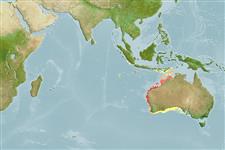
Eastern Indian Ocean: Australia.
Taille / Poids / Âge
Maturité: Lm ? range ? - ? cm
Max length : 7.4 cm SL mâle / non sexé; (Ref. 76827)
Description synthétique
Clés d'identification | Morphologie | Morphométrie
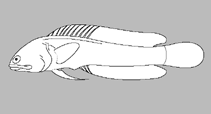
Épines dorsales (Total) : 10; Rayons mous dorsaux (Total) : 19 - 20; Épines anales: 2; Rayons mous anaux: 17 - 18; Vertèbres: 32 - 33. This species is characterized by the following: D X,19 (rarely 20); about 21-31 oblique scale rows in longitudinal series on body; no scales anterolaterally forward of verticals from 6th to 9th segmented dorsal-fin rays; a broad dark submarginal stripe on spinous dorsal fin; spine tips with pale fleshy tabs; 1-3 vomerine teeth (Ref. 76827). further diagnosed by the rigid upper jaw lacking flexible lamina posteriorly, extending 0.4-0.6 eye diameters behind posterior margin of orbit; infraorbitals are moderately robust, the second and third infraorbitals with large sensory canal openings, third infraorbital with very slight suborbital shelf; A II,17-18; vertebrae 10+22, rarely 23; lateral line terminus below segmented dorsal-fin rays 13-17; no scales forward of verticals from segmented dorsal-fin rays 6-9; vomerine teeth 1-3; the tips of dorsal-fin spines with pale fleshy tabs; dorsal fin with submarginal dark stripe and the anal fin with a narrow, dark, submarginal stripe; belly with scattered white scattered white spots (Ref. 128653).
Body shape (shape guide): elongated; Cross section: oval.
Benthic species which occurs inshore (Ref. 75154).
Cycle de vie et comportement reproducteur
Maturité | Reproduction | Frai | Œufs | Fécondité | Larves
Smith-Vaniz, W.F., 2023. Review of Indo-West Pacific jawfishes (Opistognathus: Opistognathidae), with descriptions of 18 new species. Zootaxa 5252(1):1-180. (Ref. 128653)
Statut dans la liste rouge de l'IUCN (Ref. 130435: Version 2025-2 (Global))
Menace pour l'homme
Harmless
Utilisations par l'homme
Outils
Articles particuliers
Télécharger en XML
Sources Internet
Estimations basées sur des modèles
Température préférée (Réf.
123201): 18 - 25.2, mean 18.6 °C (based on 111 cells).
Indice de diversité phylogénétique (Réf.
82804): PD
50 = 0.5000 [Uniqueness, from 0.5 = low to 2.0 = high].
Bayesian length-weight: a=0.00389 (0.00180 - 0.00842), b=3.12 (2.94 - 3.30), in cm total length, based on all LWR estimates for this body shape (Ref.
93245).
Niveau trophique (Réf.
69278): 3.4 ±0.5 se; based on size and trophs of closest relatives
Vulnérabilité de la pêche (Ref.
59153): Low vulnerability (10 of 100).
🛈