Clasificación / Nombres
Nombres comunes | Sinónimos | Catalog of Fishes(Género, Especie) | ITIS | CoL | WoRMS | Cloffa
>
Siluriformes (Catfishes) >
Trichomycteridae (Pencil or parasitic catfishes) > Trichomycterinae
Etymology: Trichomycterus: Greek, thrix = hair + Greek, mykter, -eros = nose (Ref. 45335); nigroauratus: From the latin nigro (black) and auratus (golden), referring to the colour pattern of the new species.
More on authors: Barbosa & Costa.
Entorno: milieu / zona climática / rango de profundidad / gama de distribución
Ecología
; agua dulce bentopelágico; rango de profundidad 0 - 2 m (Ref. 79612). Tropical; 22°S - 23°S, 44°W - 46°W
South America: Brazil. Upper Barreiro River drainage basin, serra de Bocaina, and upper Piquete, Pirapitinga, Alambari, Pedras, Bonito, and Campo Belo River drainage basins, serra de Mantiqueira, upper rio Paraíba do Sul basin, south-eastern Brazil (Ref. 79612).
Tamaño / Peso / Edad
Madurez: Lm ? range ? - ? cm
Max length : 7.3 cm SL macho / no sexado; (Ref. 79612)
Descripción breve
Claves de identificación | Morfología | Morfometría
Radios blandos dorsales (total) : 11 - 12; Radios blandos anales: 10 - 11; Vértebra: 35 - 36. Distinguished from all other species of the genus from south-eastern Brazil by the unique colour pattern in living specimens, consisting of golden spots on the snout, flank, above and below the midline, and the dorsum; similar to T. itatiayae and T. diabolus Bockmann, Casatti & de Pinna, 2004 and distinguished from all other species from south-eastern Brazil by possessing a broad metapterygoid, which is wider than long; distinguished from T. itatiayae by having eight pectoral rays (vs seven), anal fin origin posterior to dorsal fin base, between base of dorsal fin rays 9-12 (vs through middle of dorsal fin base, between base of dorsal fin rays 7-8), opercular and interopercular odontodes conical (vs incisiform), 16-21 opercular odontodes (vs 10-15), presence of first two infraorbital pores (vs absence), caudal fin subtruncate (vs rounded), smaller predorsal length (58.1-63.1% SL, vs 63.6-64.0% Sl) and larger eye (eye diameter 8.5-10.3% of head length, vs 7.4-8.2% of head length); distinguished from T. diabolus by the absence of the bony contact area between metapterygoid and quadrate (vs presence), moderate pectoral fin filament, about 20% of pectoral fin length (vs pectoral fin filament absent), barbels well developed, tip reaching between posterior margin of interopercular patch of odontodes and pectoral fin base (vs barbels short, tip never reaching beyond anterior margin of interopercular patch of odontodes), smaller head length (18.0-21.7% SL, vs 22.1-25.8% SL), absence of white and black bars on caudal fin (vs presence) and colour pattern with a broad black stripe on the flank (vs absence of stripe) (Ref. 79612).
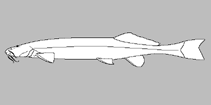
Body moderately deep, subcylindrical on anterior portion, compressed on caudal peduncle; Head subtriangular in dorsal view; snout blunt; mouth subventral; Nasal, maxillary and rictal barbels well developed; dorsal, anal and pectoral fins approximately triangular (Ref. 79612).
Ciclo vital y comportamiento de apareamiento
Madurez | Reproducción | Puesta | Huevos | Fecundidad | Larva
Barbosa, M.A. and W.J.E.M. Costa, 2008. Description of a new species of catfish from the upper rio Paraíba do Sul basin, south-eastern Brazil (Teleostei: Siluriformes: Trichomycteridae) and re-description of Trichomycterus itatiayae. aqua, Int. J. Ichthyol. 14(4):175-186. (Ref. 79612)
Situación en la Lista Roja de la UICN (Ref. 130435: Version 2025-2 (Global))
Amenaza para el ser humano
Harmless
Usos humanos
Herramientas
Informes especiales
Descargar XML
Fuentes de Internet
Estimaciones basadas en modelos
Índice de diversidad filogenética (Referencia
82804): PD
50 = 0.5000 [Uniqueness, from 0.5 = low to 2.0 = high].
Bayesian length-weight: a=0.00912 (0.00396 - 0.02102), b=2.97 (2.79 - 3.15), in cm total length, based on LWR estimates for this Genus-body shape (Ref.
93245).
Nivel trófico (Referencia
69278): 3.2 ±0.4 se; based on size and trophs of closest relatives
Vulnerabilidad pesquera (Ref.
59153): Low vulnerability (10 of 100).
🛈