Elasmobranchii (tubarões e raias) (sharks and rays) >
Squaliformes (Sleeper and dogfish sharks) >
Centrophoridae (Gulper sharks)
Etymology: Centrophorus: centr[um] (L.), prickle or sharp point; phorus, from phoreus (Gr.), bearer or carrier, referring to grooved spines on dorsal fins (See ETYFish); granulosus: granum (L.), seed or grain; -osus, Latin suffix connoting fullness, referring to its granular brown skin (See ETYFish).
More on authors: Bloch & Schneider.
Meio ambiente: milieu / Zona climática / intervalo de profundidade / faixa de distribuição
Ecologia
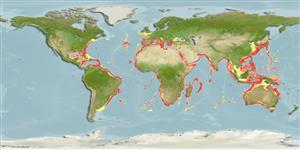
marinhas batidemersal; intervalo de profundidade 98 - 1700 m (Ref. 94782), usually 200 - 600 m (Ref. 247). Deep-water; 58°N - 43°S, 98°W - 156°E
Circumglobal: all ocean basins except in the Eastern Pacific and in the Mediterranean.
Comprimento de primeira maturação / Tamanho / Peso / Idade
Maturidade: Lm ? range ? - ? cm
Max length : 124 cm TL macho/indeterminado; (Ref. 94782); 165.0 cm TL (female)
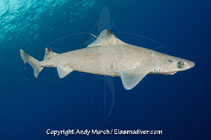
Vértebras: 106 - 115. This species is distinguished by the following characters: large (>1.5 m maximum total length); body moderately robust; head moderately long (20.6-24.9% TL, 3.9-4.9 times in total length) and very robust; snout relatively short, horizontal preorbital length 4.8-8.1% TL, moderately rounded in dorsal view; first dorsal fin low and long, its height 4.4-6.5% TL, its soft length 11.0-16.6% TL), inner margin very long which is more than length from insertion of exposed spine to fin insertion; second dorsal fin large, similar in heigfree rear tip varying from slightly elongate in small individuals with free rear tip extension 0.9-2.2% TL in individuals < 70.0 cm TL, to moderately elongate in adults, 1.9-4.1% TL; lateral trunk denticles elevated on low, broad pedicel with strongly tricuspidate crowns in juveniles < 70.0 cm TL; denticles of large individuals low, not on pedicels, crown tear-drop shaped with one long posterior cusp; upper teeth of juveniles < 50.0 cm TL are strongly oblique; upper teeth of individuals > 70.0 cm TL with erect to slightly oblique cusps; lower teeth of all sizes are much larger than upper teeth, strongly oblique, blade-like; total vertebral centra 106-115; teeth 30-37/27-32; body uniformly brownish (sometimes greyish to greyish brown), slightly paler ventrally (Ref. 94782).
Cross section: oval.
A common deepwater dogfish of the outer continental shelves and upper slopes, commonest below 200 m (Ref. 247); usually benthic and epibenthic at depths from 50-1440 m with most records from 200-600 m (Compagno, pers. comm. 07/07). Solitary (Ref. 26340). Adults feed mainly on bony fishes such as hake, epigonids, lanternfish, herring, smelts, cods, rattails, squid and crustaceans (Ref. 247, IUCN workshop 07/07). Males mature at about 105-118 cm TL (Ref. 94782). Ovoviviparous (Ref. 50449). This species is fished in Eastern Atlantic by bottom trawls, long lines, fixed bottom nets, hook and line and pelagic trawls; caught and discarded, or utilised from by-catch fisheries (IUCN discussion 07/07). Marketed smoked and dried salted for human consumption; also processed into fishmeal and a source of liver oil for squalene (Ref. 247).
Ciclo de vida ou comportamento de acasalamento
Maturidade | Reprodução | Desova | Ovos | Fecundidade | Larvas
Ovoviviparous, embryos feed solely on yolk (Ref. 50449). Young are born from 30 to 42 cm or more (Ref. 247). Distinct pairing with embrace (Ref. 205).
White, W.T., D.A. Ebert, G.J.P. Naylor, H.-H. Ho, P. Clerkin, A. Veríssimo and C.F. Cotton, 2013. Revision of the genus Centrophorus (Squaliformes: Centrophoridae): Part 1 -Redescription of Centrophorus granulosus (Bloch & Schneider), a senior synonym of C. acus and C. niaukang Teng. Zootaxa 3752(1):035-072. (Ref. 94782)
Status na Lista Vermelha da UICN (Ref. 130435: Version 2025-2 (Global))
Ameaça para os humanos
Harmless
Uso pelos humanos
Pescarias: pouco comercial
Ferramentas
Relatórios especiais
Baixar XML
Fontes da internet
Estimativas baseadas em modelos
Temperatura preferida (Ref.
123201): 7.7 - 17.3, mean 11.4 °C (based on 1031 cells).
Índice de diversidade filogenética (Ref.
82804): PD
50 = 0.5001 [Uniqueness, from 0.5 = low to 2.0 = high].
Bayesian length-weight: a=0.00204 (0.00163 - 0.00256), b=3.21 (3.14 - 3.28), in cm total length, based on LWR estimates for this species (Ref.
93245).
Nível Trófico (Ref.
69278): 4.1 ±0.4 se; based on diet studies.
Generation time: 11.4 ( na - na) years. Estimated as median ln(3)/K based on 1
growth studies.
Resiliência (Ref.
120179): Baixo, tempo mínimo de duplicação da população 4,5 - 14 anos (Fec assumed to be <100).
Vulnerabilidade da pesca (Ref.
59153): High to very high vulnerability (70 of 100).
🛈
Vulnerabilidade climática (Ref.
125649): Moderate vulnerability (43 of 100).
🛈
Nutrientes (Ref.
124155): Calcium = 5.65 [1.11, 28.95] mg/100g; Iron = 0.304 [0.071, 0.977] mg/100g; Protein = 19.9 [17.6, 22.1] %; Omega3 = 0.279 [0.102, 0.876] g/100g; Selenium = 19.5 [6.0, 56.9] μg/100g; VitaminA = 8.25 [1.82, 38.80] μg/100g; Zinc = 0.248 [0.118, 0.466] mg/100g (wet weight);