>
Perciformes/Percoidei (Perchs) >
Percidae (Perches) > Etheostomatinae
Etymology: Etheostoma: Greek, etheo = to strain + Greek, stoma = mouth; Rafinesque said "various mouths", but Jordan and Evermann suggest the name might have been intended as "Heterostoma (Ref. 45335); sitikuense: The name sitikuense comes from the Cherokee Indian word sitiku for a place of clean fishing water and is the origin for the name of Citico Creek. Citico Darter refers to the type locality of the species, where the only extant, non-introduced.
Lingkungan: lingkungan / zona iklim / kisaran kedalaman / jangkauan distribusi
Ekologi
; air tawar bentopelagis. Temperate
North America: USA. The Citico Darter occupies an approximately 3.5 river km reach of Citico Creek in Monroe County, Tennessee, just downstream of a U.S. Forest Service boundary. The creek is a tributary of Tellico Lake, an impoundment of the mainstem Little Tennessee River. The population in Citico Creek historically extended further downstream than its current distribution suggests. One individual was collected 13 December, 1979 from lower Citico Creek prior to its inundation by Tellico Lake (D. Etnier, pers. comm.). The darter is historically extirpated from Abrams Creek, a tributary of Chilhowie Lake also impounding the Little Tennessee River, in Great Smoky Mountains National Park, Blount County, Tennessee, where it is known from three specimens collected in 1937 and 1940. This and other at-risk fish species (Jenkins & Burkhead 1984; Simbeck 1990) apparently were extirpated from Abrams Creek by application of rotenone throughout the tributary system below Abrams Falls during 1957, a plan designed to reduce food and habitat competition for a Rainbow Trout fishery (Lennon & Parker 1959). Etheostoma sitikuense has been propagated and reintroduced to lower Abrams Creek, below Abrams Falls and stocked in Tellico River using Citico Creek stocks (Rakes & Shute 2005; Shute et al. 2005; Rakes & Shute 2008). (Ref. 78849).
Ukuran / Berat / umur
Kematangan: Lm ? range ? - ? cm
Max length : 5.0 cm SL jantan/; (Ref. 79849)
deskripsi pendek
Kunci identifiaksi (pengenalan) | Morfologi | Morfometrik
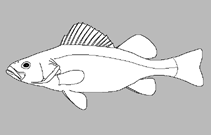
Etheostoma sitikuense is distinguished from all members of the E. percnurum species complex by more pored lateral-line scales (34 vs. 28 or fewer); intermediate anal-fin band width (range = 33–39% vs. 49–58% in E. lemniscatum and E. percnurum and 29–33% in E. marmorpinnum); fewer transverse scale rows (15 vs. 16); shorter pectoral (P1L, =240 vs. 245 or greater) and pelvic (P2L, =180 vs. 197 or greater) fins;
and wider (BW, =80 vs. 69 or less), deeper (BD1, =178 vs. 173 or less and BD2, =158 vs. 153 or less) body. E. sitikuense is further distinguished from E. percnurum and E. lemniscatum by narrower distal band on
the second-dorsal fin (range = 9–16% of fin height vs. 23–25%). From E. percnurum and E. marmorpinnum by distal caudal-fin band width (range = 15–18% of fin length vs. 12–15% in E. marmorpinnum and 17–25% in E. percnurum); percentage of area along first-dorsal fin base scaled (70% vs. 20% in E. percnurum and 100% in E. marmorpinnum); and intermediate number of scales around caudal peduncle (24 vs. 23 or 25,
respectively). From E. lemniscatum and E. marmorpinnum by fewer lateral-line scales (43 vs. 44). From E. percnurum by diffuse marbling or stippling in medial portion of second dorsal fin of nuptial males (vs. uniformly dusky); tessellations in medial portion of caudal fin of nuptial males (vs. uniformly dusky); narrower distal band on pectoral fin (range = 14–20% vs. 29–32%); and fewer caudal-fin rays (15 vs. 18); and from E. marmorpinnum by lower percentage of the belly covered by scales (10% vs. 60–80%). Means of other measurements were also informative (Ref. 79849).
Body shape (shape guide): elongated.
Siklus hidup dan perilaku kawin
Kematangan | Reproduksi, perkembang biakan | Pemijahan | telur-telur | Fekunditas | Larva
Blanton, R.E. and R.E. Jenkins, 2008. Three new darter species of the Etheostoma percnurum species complex (Percidae, subgenus Catonotus) from the Tennessee and Cumberland river drainages. Zootaxa 1963:1-24. (Ref. 79849)
Status IUCN Red List (Ref. 130435: Version 2025-2 (Global))
ancaman kepada manusia
Harmless
penggunaan manusia
Alat, peralatan
laporan khas
muat turun XML
Sumber internet
Estimasi berdasarkan model
Indeks keanekaragaman filogenetik (Acuan
82804): PD
50 = 0.5000 [Uniqueness, from 0.5 = low to 2.0 = high].
Bayesian length-weight: a=0.00676 (0.00303 - 0.01510), b=3.12 (2.94 - 3.30), in cm total length, based on LWR estimates for this Genus-body shape (Ref.
93245).
Tingkat Trofik (Acuan
69278): 3.3 ±0.5 se; based on size and trophs of closest relatives
Daya lenting (Acuan
120179): Tinggi, Waktu penggandaan populasi minimum kurang dari 15 bulan (Preliminary K or Fecundity.).
Kerentanan Penangkapan Ikan (Ref.
59153): Low vulnerability (10 of 100).
🛈