Klassifizierung / Names
Namen | Synonyme | Catalog of Fishes(Gattung, Arten) | ITIS | CoL | WoRMS | Cloffa
>
Anabantiformes (Gouramies, snakeheads) >
Nandidae (Asian leaffishes)
Etymology: Nandus: 'Nandus' is a Bengali local name, but it lacks a proper reference; ‘nanda’ is a Bengali fish name but probably for a different species (J. Müller, pers. comm., April 2021, after information from native speakers); mercatus: The specific epithet comes from the Latin noun mercatus, meaning a trading place or market. The name is used in reference to the method with which the holotype was obtained (purchased from a market), and honors the fish market, a valuable tool to i.
Umwelt: Milieu / Klimazone / Tiefenbereich / Verbreitungsgebiet
Ökologie
; süßwasser pelagisch; pH range: 4.3 - ?. Tropical; 3°N - 2°N, 103°E - 104°E
South East Asia: Indonesia, Sumatra. Currently only known from the Musi River in the vicinity of Sekayu (2°51'S 103°51'E) in southern Sumatra (Ref. 79863).
Größe / Gewicht / Alter
Geschlechtsreife: Lm ? range ? - ? cm
Max length : 7.0 cm SL Männchen/unbestimmt; (Ref. 79863)
Kurzbeschreibung
Bestimmungsschlüssel | Morphologie | Morphometrie
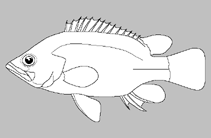
Rückenflossenstacheln (insgesamt) : 14; Rückenflossenweichstrahlen (insgesamt) : 10; Afterflossenstacheln: 3; Afterflossenweichstrahlen: 5 - 6; Wirbelzahl: 22. No unique diagnostic character was found for this species, with a combination of the following
characters diagnosing it from all congeners: body depth 43.0–43.2% SL, 15 pectoral-fin rays, 29–32 lateral line scales, 11–12 scale rows below the lateral line, and slightly concave predorsal profile. Among Sundaic Southeast Asian congeners, Nandus mercatus is distinguished from N. nebulosus in having a slightly concave
(vs. even or slightly convex) predorsal profile, rostral fossa reaching to almost half (vs. more than half) predorsal distance and fewer pectoral fin rays (15 vs. 17–19), and from N. prolixus in having fewer lateral-line
scales (29–32 vs. 33–37) and deeper body (43.0–43.2% SL vs. 37.6–40.5). It differs from South Asian congeners N. andrewi and N. nandus in having fewer lateral line scales (29–32 vs. 42–55), fewer scale rows below the lateral line (11–12 vs. 14–18), and deeper body (43.0–43.2% SL vs. 24.3–37.1). Nandus mercatus is distinguished from N. oxyrhynchus in having fewer lateral-line scales (29–32 vs. 37–42) and a more gently-sloping
predorsal profile.
Body shape (shape guide): fusiform / normal; Cross section: compressed.
Lebenszyklus und Paarungsverhalten
Geschlechtsreife | Fortpflanzung | Ablaichen | Eier | Fruchtbarkeit | Larven
Ng, H.H., 2008. Nandus mercatus (Teleostei: Perciformes: Nandidae), a new leaf fish from Sumatra. Zootaxa 1963:43-53. (Ref. 79863)
IUCN Rote Liste Status (Ref. 130435: Version 2025-2 (Global))
Bedrohung für Menschen
Harmless
Nutzung durch Menschen
Tools
Zusatzinformationen
Download XML
Internet Quellen
Schätzungen auf der Grundlage von Modellen
Phylogenetischer Diversitätsindex (Ref.
82804): PD
50 = 0.5156 [Uniqueness, from 0.5 = low to 2.0 = high].
Bayesian length-weight: a=0.01175 (0.00490 - 0.02820), b=3.06 (2.85 - 3.27), in cm total length, based on LWR estimates for this (Sub)family-body shape (Ref.
93245).
Trophische Ebene (Ref.
69278): 3.3 ±0.4 se; based on size and trophs of closest relatives
Anfälligkeit der Fischerei (Ref.
59153): Low vulnerability (10 of 100).
🛈