Elasmobranchi (squali e razze) (sharks and rays) >
Myliobatiformes (Stingrays) >
Dasyatidae (Stingrays) > Dasyatinae
Etymology: Taeniurops: From feminine Latin noun, 'taenia' = ribbon or band, ancient Greek 'oura' = tail, referring to fin fold underneath tail and Greek 'ops' = appearance; originally proposed as a subgenus of Taeniura (Richard Bajol, pers. Comm. 06/16); meyeni: Named for Franz Julius Ferdinand Meyen (1804-1840), physician and botanist (R. Bajol, pers.comm. 06/16).
Eponymy: Dr Franz Julius Ferdinand Meyen (1804–1840) was a German surgeon, a botanist and collector who was a Professor in Berlin. [...] (Ref. 128868), visit book page.
More on authors: Müller & Henle.
Taxonomic Remarks
More widely known as Taeniura melanospila Bleeker 1853, a junior synonym based on the description of a juvenile specimen.
Ambiente: milieu / zona climatica / distribuzione batimetrica / gamma di distribuzione
Ecologia
marino associati a barriera corallina; distribuzione batimetrica 1 - 500 m (Ref. 37816), usually 20 - 60 m (Ref. 30573). Tropical; 41°N - 36°S, 25°E - 77°W
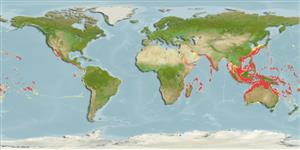
Indo-West Pacific: Persian Gulf (Ref. 68964), Red Sea and East Africa to southern Japan, Micronesia, tropical Australia and Lord Howe Island. Eastern Pacific: known only from oceanic islands (Cocos and the Galapagos) but because of sheer number, individuals may colonize the Central America mainland (Ref. 28023).
Lunghezza alla prima maturità / Dimensione / Peso / Età
Maturità: Lm 105.0, range 100 - 110 cm
Max length : 330 cm TL maschio/sesso non determinato; (Ref. 30573); peso massimo pubblicato: 150.0 kg (Ref. 11228)
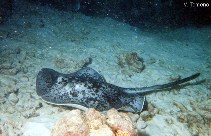
A large stingray with a circular disc, no thorns, a black and white mottled upper surface, and a deep and prominent ventral skin fold that extends to the tail tip (Ref. 6871).
Body shape (shape guide): other.
Occurs in a wide range of habitats, from shallow lagoons to outer reef slopes (Ref. 1602). Feeds on bottom fish, bivalves, crabs and shrimp (Ref. 5578). Ovoviviparous (Ref. 50449). Smallest free-swimming specimen recorded was 33 cm WD. Caught commonly by demersal tangle net fisheries, and occasionally by longline and bottom trawl fisheries. Utilized for its meat and cartilage (Ref.58048). Found singly or in aggregates and usually with jacks and cobia swimming near them (Ref. 12951). Not normally aggressive, but it has been responsible for at least one human fatality. Sought by surf and ski boat anglers in southern Africa, but usually released unharmed (Ref. 5578). Longevity record for a specimen in an aquarium is 81 days (Ref. 12951). May reach disc width in excess of 3 m (Ref. 28023).
Ciclo vitale e comportamento di accoppiamento
Maturità | Riproduzione | Deposizione | Uova | Fecondità | Larve
Exhibit ovoviparity (aplacental viviparity), with embryos feeding initially on yolk, then receiving additional nourishment from the mother by indirect absorption of uterine fluid enriched with mucus, fat or protein through specialised structures (Ref. 50449). Distinct pairing with embrace (Ref. 205). With up to 7 in a litter (Ref. 6871, 12951).
Last, P.R. and J.D. Stevens, 1994. Sharks and rays of Australia. CSIRO, Australia. 513 p. (Ref. 6871)
Stato della Lista Rossa IUCN (Ref. 130435: Version 2025-2 (Global))
Usi umani
Pesca: commerciale; Pesce da pesca sportiva: si
Strumenti
Rapporti speciali
Scarica XML
Fonti Internet
Stime basate su modelli
Temperatura preferita (Fonte Biblio.
123201): 23.3 - 29.1, mean 28 °C (based on 1102 cells).
Indice di diversità filogenetica (Fonte Biblio.
82804): PD
50 = 0.7500 [Uniqueness, from 0.5 = low to 2.0 = high].
Bayesian length-weight: a=0.00447 (0.00189 - 0.01058), b=3.12 (2.92 - 3.32), in cm total length, based on LWR estimates for this (Sub)family-body shape (Ref.
93245).
Livello trofico (Fonte Biblio.
69278): 4.2 ±0.69 se; based on food items.
Resilienza (Fonte Biblio.
120179): Molto basso, tempo minimo di raddoppiamento della popolazione più di 14 anni (Fec=7).
Vulnerabilità della pesca (Ref.
59153): Very high vulnerability (90 of 100).
🛈
Nutrienti (Ref.
124155): Calcium = 5.36 [1.38, 23.00] mg/100g; Iron = 0.325 [0.076, 0.884] mg/100g; Protein = 22.9 [20.0, 26.0] %; Omega3 = 0.111 [0.033, 0.353] g/100g; Selenium = 57.9 [17.0, 165.9] μg/100g; VitaminA = 23.7 [8.9, 66.7] μg/100g; Zinc = 0.511 [0.249, 1.019] mg/100g (wet weight);