>
Gadiformes (Cods) >
Macrouridae (Grenadiers or rattails)
Etymology: Mataeocephalus: Greek, maa, mataio = silliness + Greek,kepahle = head (Ref. 45335); kotlyari: Named for Alexander Kotlyar of P.P. Shirshov Institute of Oceanology, Russian Academy of Sciences.
Eponymy: Dr Alexander Nikolaevich Kotlyar (d: 1950) is a biologist and ichthyologist who was an associate curator of ichthyology at the Zoological Museum of Moscow University in the 1990s and is now Chief Scientist, Laboratory of Oceanic Ichthyofauna, P. [...] (Ref. 128868), visit book page.
More on authors: Sazonov, Shcherbachev & Iwamoto.
Environnement : milieu / zone climatique / profondeur / gamme de distribution
Écologie
marin benthopélagique; profondeur 412 - 1000 m (Ref. 75667), usually 700 - 900 m (Ref. 75667). Subtropical
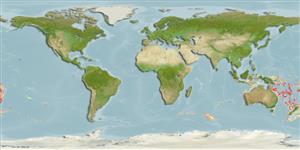
Southwestern Pacific: Australia, and Chesterfield and Bellona Plateau.
Taille / Poids / Âge
Maturité: Lm ? range ? - ? cm
Max length : 22.5 cm TL mâle / non sexé; (Ref. 75667)
Cycle de vie et comportement reproducteur
Maturité | Reproduction | Frai | Œufs | Fécondité | Larves
Sazonov, Y.I., Y.N. Shcherbachev and T. Iwamoto, 2003. The grenadier genus Mataeocephalus Berg, 1898 (Teleostei, Gadiformes, Macrouridae), with descriptions of two new species. Proc. Calif. Acad. Sci., v. 54 (no. 17):279-301. (Ref. 75667)
Statut dans la liste rouge de l'IUCN (Ref. 130435: Version 2025-2 (Global))
Menace pour l'homme
Harmless
Utilisations par l'homme
Outils
Articles particuliers
Télécharger en XML
Sources Internet
Estimations basées sur des modèles
Température préférée (Réf.
123201): 2.2 - 7.8, mean 5.6 °C (based on 208 cells).
Indice de diversité phylogénétique (Réf.
82804): PD
50 = 0.5156 [Uniqueness, from 0.5 = low to 2.0 = high].
Bayesian length-weight: a=0.00219 (0.00111 - 0.00432), b=3.20 (3.03 - 3.37), in cm total length, based on LWR estimates for this (Sub)family-body shape (Ref.
93245).
Niveau trophique (Réf.
69278): 3.4 ±0.5 se; based on size and trophs of closest relatives
Résilience (Réf.
120179): Milieu, temps minimum de doublement de population : 1,4 à 4,4 années (Preliminary K or Fecundity.).
Vulnérabilité de la pêche (Ref.
59153): Low vulnerability (13 of 100).
🛈