This website uses cookies to enhance your browsing experience and ensure the functionality of our site. For more detailed information about the types of cookies we use and how we protect your privacy, please visit our Privacy Information page.
×
Cookie Settings
This website uses different types of cookies to enhance your experience. Please select your preferences below:
分類 / 名稱 俗名 | 同種異名 | Catalog of Fishes(屬, 種) | ITIS | CoL | WoRMS | Cloffa
Teleostei > Cypriniformes (Carps) 鯉形目 (Carps) > Cyprinidae (Minnows or carps) 鯉科 (Minnows or carps) > Barbinae
Etymology: Barbus:Latin, barbus = barbel (Ref. 45335); niluferensis:Named for its type locality. Eponymy: Sir Charles Alfred Payton (1843–1926) was a British adventurer, writer, fisherman and diplomat who was British Consul to Morocco, where this barb is found. [...] (Ref. 128868), visit book page. More on authors: Turan, Kottelat & Ekmekçi.
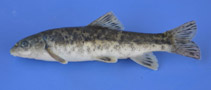
脊椎骨: 43 - 44. This species is distinguished from its congeners in Turkey and the Aegean basin by possessing a less strongly ossified last simple dorsal-fin ray and with fewer serrae along the proximal part of its posterior margin (serrated along 49-52 % of its length, vs. 56-77; 15-17 serrae, vs. 18-32) and having fewer gill rakers on the first gill arch (6-8, modally 8, vs. 7-14, modally 9-11 in the different species). It is further distinct with the following characters (none unique to the species): a small size (largest known specimen 14.6 cm SL); a short caudal fin (15.7-20.4 % SL); large and many irregular black spots on the back, as well as on the fins and flank, and small black spots on the head, extending downwards to the cheek; fleshy lips; lateral line scales 62-71; scale rows between the lateral line and the dorsal-fin origin 13-15 and between the lateral line and the anal-fin origin 8-10; last simple dorsal-fin ray weakly ossified; body depth at dorsal-fin origin 17.2-22.4 % SL; head length 23.3-25.7 % SL (Ref. 80049).
Body shape (shape guide): elongated; Cross section: compressed.
Occurs in swift flowing water, with cobble and pebble bottom (Ref. 80049).
Turan, D., M. Kottelat and F. Güler Ekmekçi, 2009. Barbus niluferensis, a new species of barbel (Teleostei: Cyprinidae) from Nilüfer River, Turkey, with re-description of B. oligolepis. Zootaxa 1981:15-28. (Ref. 80049)
系統發育多樣性指數 (參考文獻 82804): PD50 = 0.5000 [Uniqueness, from 0.5 = low to 2.0 = high].
Bayesian length-weight: a=0.00794 (0.00367 - 0.01719), b=3.05 (2.88 - 3.22), in cm total length, based on LWR estimates for this Genus-body shape (Ref. 93245).
營養階層 (參考文獻 69278): 3.1 ±0.4 se; based on size and trophs of closest relatives
回復力 (參考文獻 120179): 高度, 族群倍增時間少於 15個月 (Preliminary K or Fecundity.).
釣魚的脆弱性 (Ref. 59153): Low vulnerability (10 of 100). 🛈