Classificatie / Namen
Lokale namen | Synoniemen | Catalog of Fishes(Genus, Soort(en)) | ITIS | CoL | WoRMS | Cloffa
>
Perciformes/Uranoscopoidei (Sand dwellers) >
Pinguipedidae (Sandperches)
Etymology: Parapercis: Greek, para = the side of + Greek, perke = perch (Ref. 45335); shaoi: Named for Kwang-Tsao Shao, Taiwan.
Eponymy: Dr Kwang-Tsao Shao (d: 1951) is a Taiwanese ichthyologist. [...] (Ref. 128868), visit book page.
More on author: Randall.
Milieu: milieu / Klimaatzone / Diepte / verspreidingsgebied
Ecologie
marien benthopelagisch; diepte ? - 160 m (Ref. 79876). Tropical
Northwest Pacific: Taiwan.
Grootte / Gewicht / Leeftijd
Maturiteit: Lm ? range ? - ? cm
Max length : 15.3 cm SL mannelijk / geslacht onbekend; (Ref. 79876)
Korte beschrijving
Determinatiesleutels | Morfologie | Morfometrie
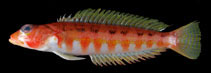
Dorsale stekels (totaal) : 5; Dorsale zachte stralen (totaal) : 21; Anale stekels: 1; Anale zachte stralen: 17; Wervels: 30. This species is distinguished by the following characters: body color in life red dorsally, white ventrally, 9 brown bars on upper third body, darkest on edges, especially ventrally; ventral 2/3 with orange-red bars aligned with the dorsal dark bars; head light red with a large curved red band extending ventrally from eye; snout with a dark orangish band along edge of upper lip; fins without dark markings except for a dark spot at base of soft rays of the dorsal fin; D V,21; A I,17; pectoral rays 16-18 (nearly all with 17); lower jaw projecting, 3 pairs of canine teeth anteriorly in lower jaw; palatine teeth absent; vomer with a row of stout conical teeth, followed by another row of very small teeth; ctenoid scales on body, becoming cycloid on nape, ventrally on abdomen, and prepelvic area; cheek with cycloid scales, small, progressively smaller and a few nonimbricate ventrally; preopercle margin no distinct sharp serrae; greatest body depth 4.7-5.1 in SL; head length (HL) 3.2-3.3 in SL; snout length 3.0-3.2 in HL; orbit diameter 3.7-4.05 in HL; interorbital width 6.25-7.35 in HL; fourth dorsal spine is the longest, 3.85-4.5 in HL; caudal fin slightly rounded with no distinct posterior prolongation centered on third branched ray; pectoral fins 3.85-4.50 in SL; pelvic fins reaching origin of anal fin, 4.35-4.85 in SL (Ref. 79876).
Body shape (shape guide): elongated.
Levenscyclus en paargedrag
Maturiteit | Voortplanting | Paaien | Eieren | Fecunditeit | Larven
Randall, J.E., 2008. Six new sandperches of the genus Parapercis from the Western Pacific, with description of a neotype for P. maculata (bloch and Schneider). The Raffles Bull. Zool. 19:159-178. (Ref. 79876)
Status op de Rode Lijst van het IUCN (Ref. 130435: Version 2025-2 (Global))
Gevaar voor de mens
Harmless
Gebruik door de mens
Tools
Speciale rapporten
Download XML
Internetbronnen
Schattingen op basis van modellen
Fylogenetische diversiteitsindex (Ref.
82804): PD
50 = 0.5000 [Uniqueness, from 0.5 = low to 2.0 = high].
Bayesian length-weight: a=0.00692 (0.00314 - 0.01524), b=3.06 (2.88 - 3.24), in cm total length, based on LWR estimates for this Genus-body shape (Ref.
93245).
Trofisch niveau (Ref.
69278): 3.5 ±0.4 se; based on size and trophs of closest relatives
Weerstandsvermogen (Ref.
120179): Hoog, minimale populatieverdubbelingstijd minder dan 15 maanden (Preliminary K or Fecundity.).
Kwetsbaarheid van de visserij (Ref.
59153): Low vulnerability (10 of 100).
🛈