Classificação / Nomes
Nomes comuns | Sinónimos | Catalog of Fishes(Género, Espécies) | ITIS | CoL | WoRMS | Cloffa
>
Gobiiformes (Gobies) >
Gobiidae (Gobies) > Gobiinae
Etymology: Glossogobius: Greek, glossa = tongue + Latin, gobius = gudgeon (Ref. 45335); muscorum: From the genitive of the Latin muscus (fly) referring to the type locality, ‘of the Fly River’.
More on authors: Hoese & Allen.
Ambiente: milieu / zona climática / intervalo de profundidade / gama de distribuição
Ecologia
; Água doce bentopelágico. Tropical; 5°S - 6°S, 141°E - 142°E
Oceania: Papua New Guinea. Glossogobius muscorum is known only from the upper Fly River system in the vicinity of Kiunga and Ningerum at distances between about 840–900 km upstream from the sea. It generally occurs in rainforest creeks at elevations below 50 m (Ref. 80299).
Tamanho / Peso / Idade
Maturidade: Lm ? range ? - ? cm
Max length : 4.5 cm SL macho/indeterminado; (Ref. 80299)
Descrição breve
Chaves de identificação | Morfologia | Morfometria
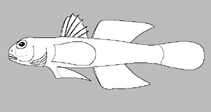
Espinhos anais: 1; Raios anais moles: 8. A species of Glossogobius with bilobed mental frenum; predorsal area with scales extending forward to just before posterior preopercular margin; cheek, operculum, pectoral base, prepelvic area and anterior midline of belly naked; first dorsal fin with 3 dark spots, centred on fourth, fifth and sixth dorsal spine, respectively; second dorsal-fin rays usually I,10; anal-fin rays I,8; pectoral-fin rays 16-17; predorsal scale count 11-13; cheek papilla lines composed of single row of papillae; papilla line 6 absent and vertebrae 11+17.
Glossogobius muscorum is most similar to G. bellendenensis from Queensland. All are characterised by reduced predorsal scale coverage, no prepelvic or pectoral base scales and
small body size (see discussion of G. bellendenensis for comparison of these species). The species can also be confused with the sympatric Glossogobius concavifrons, which has scales on the pectoral base and prepelvic area, predorsal scales reaching to near the eye, more numerous precaudal vertebrae (13–15) and a more compressed head. Separation of juveniles below 20 mm SL is difficult because the scales are not well developed in Glossogobius concavifrons at that size. (Ref. 80299).
Body shape (shape guide): fusiform / normal.
Generally occurs in rainforest creeks at elevations below 50 m (Ref. 80299).
Ciclo de vida e comportamento de acasalamento
Maturidade | Reprodução | Desova | Ovos | Fecundidade | Larvas
Hoese, D.F. and G.R. Allen, 2009. Description of three new species of Glossogobius from Australia and New Guinea. Zootaxa 1981:1-14. (Ref. 80299)
Categoria na Lista Vermelha da IUCN (Ref. 130435: Version 2025-2 (Global))
Ameaça para o homem
Harmless
Utilização humana
Ferramentas
Relatórios especiais
Descarregue XML
Fontes da internet
Estimativas baseadas em modelos
Índice de diversidade filogenética (Ref.
82804): PD
50 = 0.5000 [Uniqueness, from 0.5 = low to 2.0 = high].
Bayesian length-weight: a=0.01023 (0.00477 - 0.02194), b=3.01 (2.83 - 3.19), in cm total length, based on LWR estimates for this (Sub)family-body shape (Ref.
93245).
Nível Trófico (Ref.
69278): 3.3 ±0.4 se; based on size and trophs of closest relatives
Resiliência (Ref.
120179): Elevada, tempo mínimo de duplicação da população menor que 15 meses (Preliminary K or Fecundity.).
Vulnerabilidade da pesca (Ref.
59153): Low vulnerability (10 of 100).
🛈