Classificazione / Nomi
Nomi Comuni | Sinonimi | Catalog of Fishes(Genere, Specie) | ITIS | CoL | WoRMS | Cloffa
>
Gobiiformes (Gobies) >
Gobiidae (Gobies) > Gobiinae
Etymology: Glossogobius: Greek, glossa = tongue + Latin, gobius = gudgeon (Ref. 45335); robertsi: Named for Tyson Roberts who collected most of the type material.
Eponymy: Dr Tyson Royal Roberts (d: 1940) is an American naturalist and evolutionary biologist who has devoted most of his life to studying biodiversity, particularly that of fishes, throughout the tropics. [...] (Ref. 128868), visit book page.
More on authors: Hoese & Allen.
Ambiente: milieu / zona climatica / distribuzione batimetrica / gamma di distribuzione
Ecologia
; acqua dolce benthopelagico. Tropical; 5°S - 6°S, 141°E - 142°E
Oceania: Papua New Guinea. Glossogobius robertsi is known from several locations from the Upper Fly River system, usually in creeks above 500 m elevation. Also possibly known from the Ajkwa River in the Timika region of Papua Province (Indonesia), which lies approximately 500 km west of the Upper Fly (Ref. 80299).
Dimensione / Peso / Età
Maturità: Lm ? range ? - ? cm
Max length : 13.2 cm SL maschio/sesso non determinato; (Ref. 80299)
Breve descrizione
Chiavi di identificazione | Morfologia | Morfometria
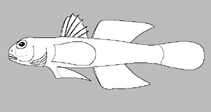
Spine anali: 1; Raggi anali molli: 8. A species of Glossogobius with mental frenum formed by short lateral lobes; cheek and operculum naked; predorsal scaled to near eye; pectoral base and prepelvic area only partly scaled; second dorsal fin-rays I,9-10; anal-fin rays I,8; pectoral rays usually 19; predorsal scale count 16-22; pelvic fin oval, slightly thickened, length subequal to or slightly longer than wide; midsides with large brown spots (much larger than eye length); no black spot posteriorly on first dorsal fin; cheek papilla lines composed of single row of papillae; papilla line 6 absent and vertebrae usually 12+16.
Glossogobius robertsi is easily separated from other species (Glossogobius
celebius, G. torrentis, G. coatesi and other species described as new herein) with a developed lobed mental frenum by the large spots on the side of the body, the reduced scale coverage on the pectoral base and prepelvic area, short round pelvic fin and absence of opercular scales (Ref. 80299).
Body shape (shape guide): fusiform / normal.
Ciclo vitale e comportamento di accoppiamento
Maturità | Riproduzione | Deposizione | Uova | Fecondità | Larve
Hoese, D.F. and G.R. Allen, 2009. Description of three new species of Glossogobius from Australia and New Guinea. Zootaxa 1981:1-14. (Ref. 80299)
Stato della Lista Rossa IUCN (Ref. 130435: Version 2025-2 (Global))
Minaccia per l'uomo
Harmless
Usi umani
Strumenti
Rapporti speciali
Scarica XML
Fonti Internet
Stime basate su modelli
Indice di diversità filogenetica (Fonte Biblio.
82804): PD
50 = 0.5000 [Uniqueness, from 0.5 = low to 2.0 = high].
Bayesian length-weight: a=0.01023 (0.00477 - 0.02194), b=3.01 (2.83 - 3.19), in cm total length, based on LWR estimates for this (Sub)family-body shape (Ref.
93245).
Livello trofico (Fonte Biblio.
69278): 3.6 ±0.4 se; based on size and trophs of closest relatives
Resilienza (Fonte Biblio.
120179): Alto, tempo minimo di raddoppiamento della popolazione meno di 15 mesi (Preliminary K or Fecundity.).
Vulnerabilità della pesca (Ref.
59153): Low vulnerability (10 of 100).
🛈