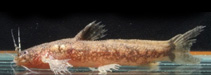
Clasificación / Nombres
Nombres comunes | Sinónimos | Catalog of Fishes(Género, Especie) | ITIS | CoL | WoRMS | Cloffa
>
Siluriformes (Catfishes) >
Akysidae (Stream catfishes) > Parakysinae
Etymology: Parakysis: Greek, para = the side of + Greek, kysthos = bladder (Ref. 45335); hystriculus: From the Latin adjective hystriculus, meaning hairy or bearded; in reference to the long accessory mandibular barbels of this species.
Entorno: milieu / zona climática / rango de profundidad / gama de distribución
Ecología
; agua dulce bentopelágico. Tropical; 1°S - 2°S, 103°E - 104°E
South East Asia : Sumatra. Known from the Lalang River drainage in southern Sumatra (Ref. 80319).
Tamaño / Peso / Edad
Madurez: Lm ? range ? - ? cm
Max length : 2.9 cm SL macho / no sexado; (Ref. 80319)
Descripción breve
Claves de identificación | Morfología | Morfometría
Parakysis hystriculus is distinguished from other members of the genus in having a combination of: branched pelvic-fin rays with anterior branch always shorter than posterior branch (vs. almost same length in congeners), lateral edges of head evenly sloping in dorsal view (vs. gently curving in congeners), anteriormost pair of accessory inner mandibular barbels longer than (vs. equal to or shorter than in congeners) distance separating bases of left and right barbel, outer mandibular barbel with one accessory barbel (vs. absent in P. anomalopteryx), mandibular laterosensory pore between bases of inner and outer mandibular barbels present (vs. absent in P. anomalopteryx), margin of lower lip with medial concavity (vs. entire in P. anomalopteryx), anal fin rounded (vs. polygonal or rectangular in P. grandis), caudal fin with narrow lobes having evenly-tapering posteromedial margins (vs. broad lobes with curved posteromedial margins in P. grandis and P. longirostris) and 10 (vs. 11 in P. verrucosus) branched rays without secondary branches (vs. with secondary
branching in P. grandis) (Ref. 80319).
Body shape (shape guide): elongated.
Ciclo vital y comportamiento de apareamiento
Madurez | Reproducción | Puesta | Huevos | Fecundidad | Larva
Ng, H.H., 2009. Parakysis hystriculus, a new species of catfish (Siluriformes: Akysidae) from Sumatra. Zootaxa 1977:39-48. (Ref. 80319)
Situación en la Lista Roja de la UICN (Ref. 130435: Version 2025-2 (Global))
Amenaza para el ser humano
Harmless
Usos humanos
Herramientas
Informes especiales
Descargar XML
Fuentes de Internet
Estimaciones basadas en modelos
Índice de diversidad filogenética (Referencia
82804): PD
50 = 0.5156 [Uniqueness, from 0.5 = low to 2.0 = high].
Bayesian length-weight: a=0.00389 (0.00180 - 0.00842), b=3.12 (2.94 - 3.30), in cm total length, based on all LWR estimates for this body shape (Ref.
93245).
Nivel trófico (Referencia
69278): 3.3 ±0.5 se; based on size and trophs of closest relatives
Vulnerabilidad pesquera (Ref.
59153): Low vulnerability (10 of 100).
🛈