Classificação / Nomes
Nomes comuns | Sinónimos | Catalog of Fishes(Género, Espécies) | ITIS | CoL | WoRMS | Cloffa
>
Ophidiiformes (Cusk eels) >
Bythitidae (Livebearing brotulas)
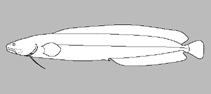
Etymology: robusta: The specific name, robusta, refers to the short, deep body (Ref. 80456).
Eponymy: Cristoforo Bellotti (1823–1919) was an Italian ichthyologist and palaeontologist, who was also very interested in the breeding of silkworms. [...] (Ref. 128868), visit book page.
More on authors: Nielsen, Ross & Cohen.
Ambiente: milieu / zona climática / intervalo de profundidade / gama de distribuição
Ecologia
marinhas bentopelágico; intervalo de profundidade 506 - 580 m (Ref. 80456). Subtropical; 28°N - 27°N, 91°W - 92°W
Atlantic Ocean: Gulf of Mexico (Ref. 80456).
Tamanho / Peso / Idade
Maturidade: Lm ? range ? - ? cm
Max length : 8.2 cm SL macho/indeterminado; (Ref. 80456)
Descrição breve
Chaves de identificação | Morfologia | Morfometria
Raios dorsais moles (total) : 85 - 93; Raios anais moles: 75 - 88; Vértebras: 48 - 51. Body robust, highest near base of pectoral fin, completely covered with oval, ca.1.5 mm, cycloid scales. Anterior segment of lateral line extending close to dorsal margin of body and from above anus along midline of body. Head profile convex, cheek and gill-cover scaled, while rest of head naked. Mouth slightly oblique with posterior margin of maxillary vertically expanded ending well behind eye. Anterior nostril closer to upper lip than to posterior nostril, both with low rim. Small opercular spine strong and pointed, almostcompletely covered by skin, and not reaching posterior margin of opercle (a few specimens with spine reaching just beyond hind margin of opercle). Ventral margin of preopercle with four distinct spines and one spine on preopercular crest (spine often covered by skin; one specimen with two spines on crest).
Origin of dorsal fin above tip of pectoral fin, anal fin origin just behind midpoint of fish (some specimens with preanal up to 59 % SL). Pectoral fin placed on mid-body level with peduncle higher than long. A distinct spine on cleithrum just above base of pectoral fin (one specimen with spine ending in a blunt tip). Anterior gill arch with 2–3 (2–4) plate-like rakers on upper branch, one long raker in the angle between the two branches and lower branch with 4–5 long rakers, followed by seven (6–9) plate-like rakers. Longest gill filament
slightly shorter than longest raker. Two minute pseudobranchial filaments (Ref. 80456).
Bellottia robusta differs from its congeners by the following combination of characters: depth at origin of anal fin 17.5–23.0 % SL, small teeth blunt or pointed, four spines on hind margin and one on crest of preopercle, distinct spine on cleithrum above base of pectoral fin, anterior gill arch with 5–6 long rakers, predorsal 44.0–49.5 % SL and precaudal vertebrae 12 (Ref. 80456).
Ciclo de vida e comportamento de acasalamento
Maturidade | Reprodução | Desova | Ovos | Fecundidade | Larvas
Nielsen, J.G., S.W. Ross and D.M. Cohen, 2009. Atlantic occurrence of the genus Bellottia (Teleostei, Bythitidae) with two new species from the Western North Atlantic. Zootaxa 2018:45-57. (Ref. 80456)
Categoria na Lista Vermelha da IUCN (Ref. 130435: Version 2025-2 (Global))
Ameaça para o homem
Harmless
Utilização humana
Ferramentas
Relatórios especiais
Descarregue XML
Fontes da internet
Estimativas baseadas em modelos
Índice de diversidade filogenética (Ref.
82804): PD
50 = 0.5312 [Uniqueness, from 0.5 = low to 2.0 = high].
Bayesian length-weight: a=0.00479 (0.00192 - 0.01191), b=3.03 (2.81 - 3.25), in cm total length, based on LWR estimates for this (Sub)family-body shape (Ref.
93245).
Nível Trófico (Ref.
69278): 3.3 ±0.5 se; based on size and trophs of closest relatives
Resiliência (Ref.
120179): Elevada, tempo mínimo de duplicação da população menor que 15 meses (Preliminary K or Fecundity.).
Vulnerabilidade da pesca (Ref.
59153): Low vulnerability (10 of 100).
🛈