>
Cypriniformes (Carps) >
Cyprinidae (Minnows or carps) > Schizothoracinae
Etymology: Schizothorax: Greek, schizein = to divide * Greek, thorax = breast (Ref. 45335); nudiventris: From the Latin nudus meaning naked and venter, abdomen, possessive; nudiventris, in reference to the scalesless thorax and abdomen anterior to the pelvic-fin origin of this species (Ref. 80483).
More on authors: Yang, Chen & Yang.
Meio ambiente: milieu / Zona climática / intervalo de profundidade / faixa de distribuição
Ecologia
; Água doce pelágico(a,os,as). High altitude
Asia: China. The species is known from the mainstream and tributaries of the upper Lancang Jiang (upper Mekong River) drainage (Ref. 80483).
Tamanho / Peso / Idade
Maturidade: Lm ? range ? - ? cm
Max length : 24.3 cm SL macho/indeterminado; (Ref. 80483)
Descrição suscinta
Chaves de identificação | Morfologia | Morfometria
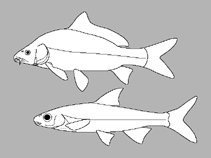
Schizothorax nudiventris can be distinguished from its congeners by a combination of the following characters: snout blunt; upper lip thin; lower lip developed, trilobed, the median lobe minute, the lateral lobes forming a splayed. Postlabial groove continuous. Thorax scaleless in mature individuals; distal onefourth of last unbranched dorsal-fin ray soft and articulated, proximal three-fourths of it strong, with 15−21 serrae along its posterior edge; pelvic-fin origin beneath or posterior to vertical through dorsal-fin origin; irregular black spots scattered along lateral line on flank; eye diameter mean 92.0 % of maxillary barbel. Schizothorax nudiventris is further distinguished from the sympatric S. lissolabiatus Tsao and S. dolichonema Herzenstein by the absence (vs. presence) of a horny sheath on the lower jaw and having a smooth, trilobed lower lip (vs. bi-lobed in S. lissolabiatus and papillated and single-lobed lower lip in S. dolichonema). Schizothorax nudiventris is further distinguished from another species from the same drainage, S. yunnanensis, by having a continuous (vs. discontinuous) postlabial groove; last unbranched dorsal-fin ray strong (vs. soft); length of barbels equal to or longer (vs. shorter) than eye diameter. Schizothorax nudiventris resembles the sympatric S. lantsangensis Tsao, with which is shares a scalesless thorax, lower lip tri-lobed and postlabial groove continuous, but differs from it in having larger eyes [diameter 57.2−160.0 % (mean 92.0) maxillary barbel vs. 33.9−60.1 % (mean 46.1)]; scales in transverse series from dorsal-fin origin to lateral line 27−34 (12*) (vs. 33−40 (9*)); median lobe of lower lip distinct, free and smooth (vs. indistinct and covered with papillae) (Ref. 80483).
Ciclo de vida ou comportamento de acasalamento
Maturidade | Reprodução | Desova | Ovos | Fecundidade | Larvas
Yang, J., X. Chen and J. Yang, 2009. The identity of Schizothorax griseus Pellegrin, 1931, with descriptions of three new species of schizothoracine fishes (Teleostei: Cyprinidae) from China. Zootaxa 2006:23-40. (Ref. 80483)
Status na Lista Vermelha da UICN (Ref. 130435: Version 2025-2 (Global))
Ameaça para os humanos
Harmless
Uso pelos humanos
Ferramentas
Relatórios especiais
Baixar XML
Fontes da internet
Estimativas baseadas em modelos
Índice de diversidade filogenética (Ref.
82804): PD
50 = 0.5000 [Uniqueness, from 0.5 = low to 2.0 = high].
Bayesian length-weight: a=0.00776 (0.00377 - 0.01598), b=3.01 (2.84 - 3.18), in cm total length, based on LWR estimates for this Genus-body shape (Ref.
93245).
Nível Trófico (Ref.
69278): 2.6 ±0.2 se; based on size and trophs of closest relatives
Resiliência (Ref.
120179): médio(a), tempo mínimo de duplicação da população 1,4 - 4,4 anos (Preliminary K or Fecundity.).
Vulnerabilidade da pesca (Ref.
59153): Low vulnerability (20 of 100).
🛈