Clasificación / Nombres
Nombres comunes | Sinónimos | Catalog of Fishes(Género, Especie) | ITIS | CoL | WoRMS | Cloffa
>
Characiformes (Characins) >
Curimatidae (Toothless characins)
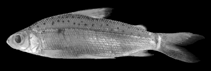
Etymology: Steindachnerina: Named after Franz Steindachner, 1876; naturalist, ichthyologist that studied the fauna of Galápagos; notograptos: Name from a Greek feminine adjective, meaning having markings on the back, refers to the presence of dark brown dots on the dorsolateral portion of body.
Eponymy: Franz Steindachner (1834–1919) was an Austrian zoologist who specialised in herpetology and ichthyology. [...] (Ref. 128868), visit book page.
More on authors: Lucinda & Vari.
Entorno: milieu / zona climática / rango de profundidad / gama de distribución
Ecología
; agua dulce pelagic-neritic. Tropical
South America: Brazil.
Tamaño / Peso / Edad
Madurez: Lm ? range ? - ? cm
Max length : 10.6 cm SL macho / no sexado; (Ref. 80500)
Descripción breve
Claves de identificación | Morfología | Morfometría
Vértebra: 29. This species is autapomorphically distinct from its congeners in having a small, medial, lobulate process located on each side of the posterior limit of the medial fold (mf) of the buccopharyngeal complex; differs further with the exception of S. argentea, S. bimaculata, S. binotata, S. conspersa, S. corumbae,
and S. leucisca, in possessing three weakly developed, longitudinally oriented, fleshy folds on the roof of the oral cavity rather than having three well developed, longitudinally oriented, fleshy flaps and/or one or more series of lobulate fleshy processes in that region. The 57-64 scales in the lateral line from the supracleithrum to the hypural joint separates this species from S. argentea, S. bimaculata, S. conspersa, and S. corumbae with 53 or fewer scales along the lateral line to the hypural joint and from S. binotata which has 67 to 70 scales along that series. This species can be further distinguished from S. leucisca in details of the pigmentation pattern of the dorsolateral region (three irregular series of small, dark spots on the dorsolateral surface of the body above the midlateral band vs. with either one or two series of larger spots about one-half size of pupil or very narrow bars of that vertical extent, respectively), and midlateral surface of the body (rounded to horizontally elongate diffuse dark spot larger than exposed parts of scales positioned over lateral line slightly anterior to vertical through origin of dorsal fin vs. spot
absent, respectively), and the profile of the anterior portion of the snout (somewhat rounded vs. more pointed, respectively) (Ref. 80500).
Ciclo vital y comportamiento de apareamiento
Madurez | Reproducción | Puesta | Huevos | Fecundidad | Larva
Lucinda, P.H.F. and R.P. Vari, 2009. New Steindachnerina species (Teleostei: Characiformes: Curimatidae) from the Rio Tocantins Drainage. Copeia 2009(1):142-147. (Ref. 80500)
Situación en la Lista Roja de la UICN (Ref. 130435: Version 2025-2 (Global))
Amenaza para el ser humano
Harmless
Usos humanos
Herramientas
Informes especiales
Descargar XML
Fuentes de Internet
Estimaciones basadas en modelos
Índice de diversidad filogenética (Referencia
82804): PD
50 = 0.5000 [Uniqueness, from 0.5 = low to 2.0 = high].
Bayesian length-weight: a=0.01479 (0.00659 - 0.03318), b=3.01 (2.84 - 3.18), in cm total length, based on LWR estimates for this Genus-body shape (Ref.
93245).
Resiliencia (Referencia
120179): Alto, población duplicada en un tiempo mínimo inferior a 15 meses (Preliminary K or Fecundity.).
Vulnerabilidad pesquera (Ref.
59153): Low vulnerability (10 of 100).
🛈