Klassifizierung / Names
Namen | Synonyme | Catalog of Fishes(Gattung, Arten) | ITIS | CoL | WoRMS | Cloffa
>
Siluriformes (Catfishes) >
Sisoridae (Sisorid catfishes) > Sisorinae
Etymology: Glyptothorax: Greek, glyptes = carver + Greek, thorax = breast (Ref. 45335); ketambe: This species is named after its type locality, the Ketambe research station, which is world
renowned as a site for the study of the Sumatran orangutan (Pongo abelii). Used as a noun in apposition.
Umwelt: Milieu / Klimazone / Tiefenbereich / Verbreitungsgebiet
Ökologie
; süßwasser benthopelagisch. Tropical
South East Asia. Indonesia. Known from the Alas River drainage in northern Sumatra, which drains the eastern face of the Leuser Mountain Range and the western face of the Central Gajo Mountain Range, debouching into the Indian Ocean (Ref. 80807).
Größe / Gewicht / Alter
Geschlechtsreife: Lm ? range ? - ? cm
Max length : 10.0 cm SL Männchen/unbestimmt; (Ref. 80807)
Kurzbeschreibung
Bestimmungsschlüssel | Morphologie | Morphometrie
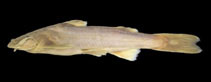
Glyptothorax ketambe can be distinguished from all other Sundaic congeners except G.
schmidti and G. siamensis in having a color pattern consisting of a dark brown body with yellowish midlateral and mid-dorsal stripes. It differs from G. schmidti in having a deeper caudal peduncle (7.6–8.9% SL vs. 5.8–7.3) and a less posteriorly-extended thoracic adhesive apparatus (not reaching vs. reaching to the level ofthe base of the last pectoral-fin ray) and from G. siamensis in having a narrower head (16.1–17.9% SL vs. 17.2–20.1) and an almost straight (vs. noticeably curved) lateral margin of the thoracic adhesive apparatus. There are eight other congeners from mainland Southeast Asia that share a similar color pattern of a
dark-colored body (with or without distinct pale midlateral and mid-dorsal stripes) with G. ketambe: G. coracinus, G. interspinalus, G. laosensis, G. longicauda, G. longjiangensis, G. strabonis, G. trilineatus and G.
zanaensis. Glyptothorax ketambe is distinguished from G. coracinus in having a wider interorbital distance (29.0–31.2% HL vs. 26.2–26.7), from G. interspinalus in having a deeper caudal peduncle (7.6–8.9% SL vs.
6.1–8.0) and a narrower head (16.1–17.9% SL vs. 17.2–22.1), from G. laosensis in having a narrower head (16.1–17.9% SL vs. 19.2–21.1) and a less posteriorly-extended thoracic adhesive apparatus (not reaching vs. reaching beyond the level of the base of the last pectoral-fin ray), and from G. longicauda in having a shorter
caudal peduncle (20.1–22.9% SL vs. 23.6) and fewer vertebrae (37–38 vs. 42). It differs from G. longjiangensis in having tubercles on the dorsal surface of the head with a single, median ridge (vs. with anastomosing tubercles with multiple ridges) and without any pale markings on the nuchal plate (vs. part or all of the nuchal plate pale-colored), from G. strabonis in having a larger eye (7.5–9.6% HL vs. 6.2–6.5), interorbital distance (29.0–31.2% HL vs. 26.0–27.2) and fewer serrations on the posterior margin of the pectoral spine (9–12 vs. 14–16), from G. trilineatus in having a longer caudal peduncle (20.1–22.9% SL vs. 16.7–18.4), and from G. zainaensis in having a shorter adipose-fin base (12.0–14.5% SL vs. 14.4–18.4), and a less posteriorly-extended thoracic adhesive apparatus (not reaching to the level of the base of the last pectoralfin ray vs. reaching beyond) (Ref. 80807).
Body shape (shape guide): elongated.
Lebenszyklus und Paarungsverhalten
Geschlechtsreife | Fortpflanzung | Ablaichen | Eier | Fruchtbarkeit | Larven
Ng, H.H. and R.K. Hadiaty, 2009. Glyptothorax ketambe, a new catfish (Teleostei: Sisoridae) from northern Sumatra. Zootaxa 2085:61-68. (Ref. 80807)
IUCN Rote Liste Status (Ref. 130435: Version 2025-2 (Global))
Bedrohung für Menschen
Harmless
Nutzung durch Menschen
Fischereien: nicht kommerziell
Tools
Zusatzinformationen
Download XML
Internet Quellen
Schätzungen auf der Grundlage von Modellen
Phylogenetischer Diversitätsindex (Ref.
82804): PD
50 = 0.5000 [Uniqueness, from 0.5 = low to 2.0 = high].
Bayesian length-weight: a=0.00794 (0.00365 - 0.01726), b=3.02 (2.85 - 3.19), in cm total length, based on LWR estimates for this Genus-body shape (Ref.
93245).
Trophische Ebene (Ref.
69278): 3.2 ±0.4 se; based on size and trophs of closest relatives
Widerstandsfähigkeit (Ref.
120179): mittel, Verdopplung der Population dauert 1,4 - 4,4 Jahre. (Preliminary K or Fecundity.).
Anfälligkeit der Fischerei (Ref.
59153): Low vulnerability (10 of 100).
🛈