Klassifizierung / Names
Namen | Synonyme | Catalog of Fishes(Gattung, Arten) | ITIS | CoL | WoRMS | Cloffa
>
Aulopiformes (Grinners) >
Synodontidae (Lizardfishes) > Synodontinae
Etymology: Synodus: Greek, syn, symphysis = grown together + Greek, odous = teeth (Ref. 45335); isolatus: Name refers to its type locality, the Easter I., the most isolated island of the Indo-Pacific region.
More on author: Randall.
Umwelt: Milieu / Klimazone / Tiefenbereich / Verbreitungsgebiet
Ökologie
seewasser benthopelagisch; tiefenbereich 10 - 18 m (Ref. 80927). Tropical
Verbreitung
Territorien | FAO Gebiete | Ökosysteme | Vorkommen | Punkt Karte | Einführungen | Faunafri
Southeast Pacific: Easter Island.
Größe / Gewicht / Alter
Geschlechtsreife: Lm ? range ? - ? cm
Max length : 20.2 cm SL Männchen/unbestimmt; (Ref. 80927); 24.1 cm SL (female)
Kurzbeschreibung
Bestimmungsschlüssel | Morphologie | Morphometrie
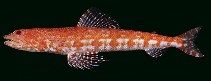
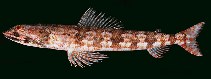
Rückenflossenweichstrahlen (insgesamt) : 14 - 15; Afterflossenweichstrahlen: 9 - 10. This species is distinct in having the following characters: D 14-15; A 9-10; pectoral rays 12-14; lateral-line scales 57-59; 4½ or 5 scales between lateral line and base of dorsal fin; median predorsal scales 15-16; vertebrae 59-60, predorsal 15-15.5; peritoneal spots 1-8; anterior palatine teeth of inner row longer than posterior teeth; preopercle fully scaled; posterior flap of anterior nostril leaf-like and short, just reaching or extending slightly beyond rear edge of posterior nostril when laid back; depth of body 6.6-7.45 in SL; pectoral fins reaching well posterior to a line connecting dorsal- and pelvic-fin origins, fin length 2.1-2.4 in HL; alcohol preserved color pale brown, body with 8 dark-edged brown bars, each with 3 constrictions, 2 above and 1 below lateral line; even-numbered bars darker; 2 irregular dark brown bars across lips, larger one below eye, the other just before corner of mouth; a pair of very small black spots dorsally at tip of snout, each followed by a dark brown line, the 2 lines merging posteriorly on snout; 2 dark brown spots on adipose fin; remaining fins pale, anterior dorsal fin rays with faint dark spots; when fresh, the color is orangish brown dorsally, white ventrally, white spaces between dark bars on body just above lateral line with horizontal row of 2-4 small dark brown blotches, 1 per scale ; white spaces below lateral line with 2 small interconnected vertically aligned reddish orange blotches; rows of red spots on rays of dorsal, anal and caudal fins; 2 broad black bands across lips; irregular red cross bands on caudal fin lobes (Ref. 80927).
Body shape (shape guide): elongated.
Collected on rock and sandy bottom with rotenone and with about 250 m hook and line (Ref. 80927).
Lebenszyklus und Paarungsverhalten
Geschlechtsreife | Fortpflanzung | Ablaichen | Eier | Fruchtbarkeit | Larven
Randall, J.E., 2009. Five new Indo-Pacific lizardfishes of the genus Synodus (Aulopiformes: Synodontidae). Zoological Studies 48(3):407-417. (Ref. 80927)
IUCN Rote Liste Status (Ref. 130435: Version 2025-2 (Global))
Bedrohung für Menschen
Harmless
Nutzung durch Menschen
Tools
Zusatzinformationen
Download XML
Internet Quellen
Schätzungen auf der Grundlage von Modellen
Phylogenetischer Diversitätsindex (Ref.
82804): PD
50 = 0.5000 [Uniqueness, from 0.5 = low to 2.0 = high].
Bayesian length-weight: a=0.00468 (0.00225 - 0.00972), b=3.15 (2.98 - 3.32), in cm total length, based on LWR estimates for this Genus-body shape (Ref.
93245).
Trophische Ebene (Ref.
69278): 4.2 ±0.8 se; based on size and trophs of closest relatives
Widerstandsfähigkeit (Ref.
120179): hoch, Verdopplung der Population dauert weniger als 15 Monate. (Preliminary K or Fecundity.).
Anfälligkeit der Fischerei (Ref.
59153): Low vulnerability (19 of 100).
🛈