Classificatie / Namen
Lokale namen | Synoniemen | Catalog of Fishes(Genus, Soort(en)) | ITIS | CoL | WoRMS | Cloffa
>
Gymnotiformes (Knifefishes) >
Hypopomidae (Bluntnose knifefishes)
Etymology: Brachyhypopomus: Greek, brachys, eia = short + Greek, hypo = under + Greek, poma, -atos = cover (Ref. 45335); bullocki: Named for Theodore Holmes Bullock, a pioneer of the comparative neurobiology of both invertebrates and vertebrates.
neurobiology of both invertebrates and vertebrates.
Eponymy: Dr Theodore Holmes Bullock (1915–2005) was a comparative neurobiologist, interested in both invertebrates and vertebrates. [...] (Ref. 128868), visit book page.
Milieu: milieu / Klimaatzone / Diepte / verspreidingsgebied
Ecologie
; zoet water benthopelagisch. Tropical
South America: Orinoco basin in Venezuela and Colombia; rio Branco drainage in Guyana and Brazil, as well as in the upper rio Negro near the mouth of the rio Branco, but is not known from elsewhere in the Amazon system, or in the Guianas.
Grootte / Gewicht / Leeftijd
Maturiteit: Lm ? range ? - ? cm
Max length : 22.1 cm TL mannelijk / geslacht onbekend; (Ref. 81045)
Korte beschrijving
Determinatiesleutels | Morfologie | Morfometrie
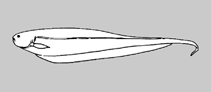
Anale zachte stralen: 196 - 233. Can be distinguished by the following combination of features: elongated caudal filament reaching up to 45% TL in reproductive males; 6-11 wide, evenly spaced saddles of pigment over dorsum connecting to lateral bands; mesocoracoid bone present; large eye, 15.5-19.2% HL; short abdomen, usually with 12 pre-caudal vertebrae (range 11-13); poorly ossified third and fourth (outermost) branchiostegal rays, much enlarged distally, covering distal portions of the first two branchiostegal rays externally and contributing to bulbous appearance of opercular region (Ref. 81045).
Facultative air-breathing in the genus (Ref. 126274); Inhabits clear, shallow, standing water in open savanna, or savanna mixed with stands of Mauritia palm. Collected in the vegetation along the banks of small pools fed by steams. Occurs inactive during the day among the stems and roots of emergent grasses and sedges. Encountered only in very low conductivity water (<25 μS/cm) where it usually co-inhabits with Brachyhypopomus brevirostris. The electric organ discharge waveform is biphasic, 0.9-1.6 milliseconds in duration, and the pulse rate ranges from 20 to 80 Hz (Ref. 81045).
Levenscyclus en paargedrag
Maturiteit | Voortplanting | Paaien | Eieren | Fecunditeit | Larven
Sullivan, J.P., 2009. Brachyhypopomus bullocki, a new species of electric knifefish (Gymnotiformes: Hypopomidae) from northern South America. Proc. Acad. Nat. Sci. Phila. 158:183-192. (Ref. 81045)
Status op de Rode Lijst van het IUCN (Ref. 130435: Version 2025-2 (Global))
Gevaar voor de mens
Harmless
Gebruik door de mens
Tools
Speciale rapporten
Download XML
Internetbronnen
Schattingen op basis van modellen
Fylogenetische diversiteitsindex (Ref.
82804): PD
50 = 0.5000 [Uniqueness, from 0.5 = low to 2.0 = high].
Bayesian length-weight: a=0.00372 (0.00141 - 0.00980), b=3.06 (2.83 - 3.29), in cm total length, based on LWR estimates for this (Sub)family-body shape (Ref.
93245).
Trofisch niveau (Ref.
69278): 3.2 ±0.4 se; based on size and trophs of closest relatives
Kwetsbaarheid van de visserij (Ref.
59153): Low vulnerability (12 of 100).
🛈