klasifikasi / Nama
Nama-nama umum | Sinonim (persamaan) | Catalog of Fishes(Marga, Jenis) | ITIS | CoL | WoRMS | Cloffa
>
Cichliformes (Cichlids, convict blennies) >
Cichlidae (Cichlids) > Geophaginae
Etymology: Gymnogeophagus: Greek, gymnos = naked + Greek, gea = the earth + Greek, phaegein, to eat (Ref. 45335); tiraparae: Named for María Luisa Tirapare, founded the now disappeared town of San Borja del Yí (close to the first locality where this new species was found), the last native town in Uruguayan land, where African slaves, gauchos and other outsiders lived together.
Eponymy: María Luisa Tirapare was an 18th-century Guaraní woman who founded the now disappeared town of San Borja del Yí (close to the type locality), the last native town in Uruguayan land, where natives, fugitive African slaves, gaúchos (cowboys), and [...] (Ref. 128868), visit book page.
Lingkungan: lingkungan / zona iklim / kisaran kedalaman / jangkauan distribusi
Ekologi
; air tawar bentopelagis. Tropical
South America: middle rio Negro basin, including main tributaries (lower rio Uruguay basin) and in rio Tacuarí (laguna Mirim basin).
Ukuran / Berat / umur
Kematangan: Lm ? range ? - ? cm
Max length : 10.2 cm SL jantan/; (Ref. 128591)
deskripsi pendek
Kunci identifiaksi (pengenalan) | Morfologi | Morfometrik
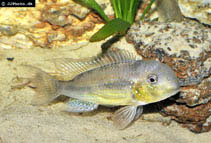
Duri punggung (Keseluruhan (total)) : 13 - 16; duri punggung lunak (Keseluruhan (total)) : 7 - 12; Duri dubur: 3; Sirip dubur lunak: 6 - 9. Diagnosed from all congeners by having the following unique characters: adipose hump on head deeper than the dorsal-fin upper border, adipose hump with anterior profile vertical, extending from the upper lip to the dorsal-fin origin; absence of transversal bands on body; two horizontal series of moderately elongated light blue dots between dorsal-fin spines; a series of light blue stripes between soft rays, sometimes merged with the second series of elongated dots, and always with a red ground color between series of dots; and caudal fin with dots vertically aligned on its distal border. Other characters useful to differentiate it from other species include: E1 scale count 27-30, 96% with 28-30 (vs. 26-29, 74% with 26-27 in Gymnogeophagus gymnogenys); absence of a black line anterior to eye (vs. present in Gymnogeophagus gymnogenys and Gymnogeophagus caguazuensis); body depth 33.6-41.4% SL (vs. 23-29% SL and 41.2-43.3% SL in Gymnogeophagus gymnogenys and Gymnogeophagus australis, respectively). Differs further from Gymnogeophagus australis by the following characters: presence of six to eight parallel light green bands on body (vs. absence); snout to dorsal-fin origin length 30.5-38.4% SL (vs. 23.6-30.7% SL); and head depth 81-104% HL (vs. 109.7-116.2% HL) (Ref. 80696).
Found in large rivers with clear water, sandy or rocky bottoms and with little vegetation (Ref. 80696). Females were encountered holding juveniles in their mouths during the end of spring and summer (Ref. 80696).
Siklus hidup dan perilaku kawin
Kematangan | Reproduksi, perkembang biakan | Pemijahan | telur-telur | Fekunditas | Larva
González-Bergonzoni, I., M. Loureiro and S. Oviedo, 2009. A new species of Gymnogeophagus from the río Negro and río Tacuarí basins, Uruguay (Teleostei: Perciformes). Neotrop. Ichthyol. 7(1):19-24. (Ref. 80696)
Status IUCN Red List (Ref. 130435: Version 2025-2 (Global))
ancaman kepada manusia
Harmless
penggunaan manusia
Perikanan: perikanan swasembada
Alat, peralatan
laporan khas
muat turun XML
Sumber internet
Estimasi berdasarkan model
Indeks keanekaragaman filogenetik (Acuan
82804): PD
50 = 0.5000 [Uniqueness, from 0.5 = low to 2.0 = high].
Bayesian length-weight: a=0.02344 (0.01310 - 0.04196), b=3.00 (2.84 - 3.16), in cm total length, based on LWR estimates for this species & (Sub)family-body (Ref.
93245).
Tingkat Trofik (Acuan
69278): 3.3 ±0.5 se; based on size and trophs of closest relatives
Kerentanan Penangkapan Ikan (Ref.
59153): Low vulnerability (10 of 100).
🛈