>
Gobiiformes (Gobies) >
Gobiidae (Gobies) > Gobiinae
Etymology: Elacatinus: Greek, elakatines = fusiform fishes preserved in salt (Ref. 45335); colini: Named for Patrick L. Colin, in recognition of his exceptional doctoral thesis on the comparative biology of western Atlantic gobies of the genus Elacatinus, and for his help in this research.
Eponymy: Patrick Lynn ‘Pat’ Colin (d: 1946) is a coral-reef biologist at the Coral Reef Research Foundation. [...] (Ref. 128868), visit book page.
More on authors: Randall & Lobel.
Entorno: milieu / zona climática / rango de profundidad / gama de distribución
Ecología
marino asociado a arrecife, usually 3 - 16 m (Ref. 81169). Tropical; 17°N - 16°N, 88°W - 89°W
Caribbean Sea: Belize.
Tamaño / Peso / Edad
Madurez: Lm ? range ? - ? cm
Max length : 3.2 cm SL macho / no sexado; (Ref. 81169); 3.4 cm SL (female)
Descripción breve
Claves de identificación | Morfología | Morfometría
Espinas dorsales (total) : 8; Radios blandos dorsales (total) : 10 - 12; Espinas anales: 1; Radios blandos anales: 10 - 11. Dorsal rays VII + I, 11 (10–12, rarely 10); anal rays I,10 (10–11, two of 15 with 11); pectoral
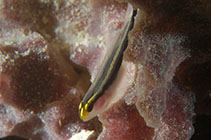
rays 17–19 (usually 18, one of 30 with 19); no scales; body and fins covered with thick adherent mucus; mouth subterminal; tongue truncate; no rostral frenum; color in alcohol pale yellowish gray with a midlateral black stripe from eye nearly to posterior end of caudal fin, about a pupil diameter in width on head, broadening to about an eye diameter in width on body; a blackish line extending posteriorly from above upper edge of eye, continuing below base of dorsal fins, and extending into dorsal part of caudal fin; fins otherwise translucent gray; color in life of body above black lateral stripe bluish to greenish gray with a bright white stripe as wide as pupil passing between black stripe and black line, becoming yellow on head as it nears upper edge of eye; dorsal part of iris brilliant yellow; snout and lips dusky yellow; a median brilliant yellow band on snout extending into anterior interorbital; ventral part of head and body whitish (Ref. 81169).
Body shape (shape guide): fusiform / normal.
Collected with a hand net from a patch reef of mixed coral and sponge on sloping sand substratum at 5 m (Ref. 81169).
Ciclo vital y comportamiento de apareamiento
Madurez | Reproducción | Puesta | Huevos | Fecundidad | Larva
Randall, J.E. and P.S. Lobel, 2009. A literature review of the sponge-dwelling gobiid fishes of the genus Elacatinus from the western Atlantic, with description of two new Caribbean species. Zootaxa 2133:1-19. (Ref. 81169)
Situación en la Lista Roja de la UICN (Ref. 130435: Version 2025-2 (Global))
Amenaza para el ser humano
Harmless
Usos humanos
Herramientas
Informes especiales
Descargar XML
Fuentes de Internet
Estimaciones basadas en modelos
Índice de diversidad filogenética (Referencia
82804): PD
50 = 0.5000 [Uniqueness, from 0.5 = low to 2.0 = high].
Bayesian length-weight: a=0.01023 (0.00477 - 0.02194), b=3.01 (2.83 - 3.19), in cm total length, based on LWR estimates for this (Sub)family-body shape (Ref.
93245).
Nivel trófico (Referencia
69278): 3.4 ±0.3 se; based on size and trophs of closest relatives
Vulnerabilidad pesquera (Ref.
59153): Low vulnerability (10 of 100).
🛈