>
Ophidiiformes (Cusk eels) >
Dinematichthyidae (Viviparous brotula)
Etymology: Alionematichthys: Name from Latin alius meaning the other or different, and nematichthys, the stem of the genus name Dinematichthys, to which this genus is most similar.
More on author: Alcock.
Entorno: milieu / zona climática / rango de profundidad / gama de distribución
Ecología
marino asociado a arrecife; rango de profundidad 0 - 12 m (Ref. 90102). Subtropical
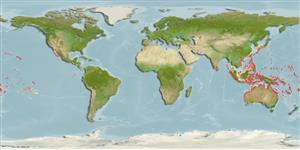
Eastern Indian Ocean to Western Central Pacific: Andaman Is. to Sumatra, Thailand, Vietnam, Taiwan and the Ryukyu Is., north to Australia (up to Lord Howe I.) and eastwards to Micronesia, Line Is., Tuamotus and Pitcairn Group.
Tamaño / Peso / Edad
Madurez: Lm ? range ? - ? cm
Max length : 8.4 cm SL macho / no sexado; (Ref. 81230)
Descripción breve
Claves de identificación | Morfología | Morfometría
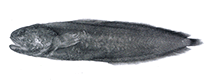
Radios blandos dorsales (total) : 72 - 88; Radios blandos anales: 55 - 70; Vértebra: 40 - 45. This species is distinguished by the following characters: D 72-88; A 55-70; moderately large eyes (1.7-2.8%SL); slender body; blunt snout, many cirri; cheeks with scales and rarely 1-2 scales above opercular spine; with upper preopercular pore; outer pseudoclasper broad-based, large, often extending beyond hood when in resting position, while the inner one is small, with equal anterior and posterior lobes; otolith length to height 1.9-2.1, with gently curved dorsal rim; otolith length to sulcus length 1.5-1.6, ostium length to caudal length 3.5-4.5; vertebrae 11-12 + 29-33 = 40-45 (Ref. 81230).
Body shape (shape guide): elongated; Cross section: compressed.
Occurs in holes and crevices of coralline and volcanic rock (Ref. 71230). Cryptic and solitary in shallow water (<12 m) (Ref 90102).
Ciclo vital y comportamiento de apareamiento
Madurez | Reproducción | Puesta | Huevos | Fecundidad | Larva
Møller, P.R. and W. Schwarzhans, 2008. Review of the Dinematichthyini (Teleostei, Bythitidae) of the Indo-west Pacific, Part IV. Dinematichthys and two new genera with descriptions of nine new species. The Beagle 24:87-146. (Ref. 81230)
Situación en la Lista Roja de la UICN (Ref. 130435: Version 2025-2 (Global))
Amenaza para el ser humano
Harmless
Usos humanos
Pesquerías: sin interés
Herramientas
Informes especiales
Descargar XML
Fuentes de Internet
Estimaciones basadas en modelos
Temperatura preferida (Referencia
123201): 24.3 - 29.3, mean 28.4 °C (based on 2464 cells).
Índice de diversidad filogenética (Referencia
82804): PD
50 = 0.5005 [Uniqueness, from 0.5 = low to 2.0 = high].
Bayesian length-weight: a=0.00389 (0.00180 - 0.00842), b=3.12 (2.94 - 3.30), in cm total length, based on all LWR estimates for this body shape (Ref.
93245).
Nivel trófico (Referencia
69278): 3.3 ±0.5 se; based on size and trophs of closest relatives
Vulnerabilidad pesquera (Ref.
59153): Low vulnerability (10 of 100).
🛈
Nutrientes (Ref.
124155): Calcium = 110 [46, 248] mg/100g; Iron = 0.978 [0.486, 1.879] mg/100g; Protein = 17.5 [14.9, 20.1] %; Omega3 = 0.162 [0.080, 0.318] g/100g; Selenium = 11.3 [4.6, 30.4] μg/100g; VitaminA = 71.8 [18.0, 286.8] μg/100g; Zinc = 1.7 [1.0, 2.7] mg/100g (wet weight);