Classification / Noms
Noms communs | Synonymes | Catalog of Fishes(Genre, Espèce) | ITIS | CoL | WoRMS | Cloffa
>
Blenniiformes (Blennies) >
Labrisomidae (Labrisomids)
Etymology: Cottoclinus: Derived generic names Cottus and Clinus, referring to the cottid-like appearance of this blenny; canops: Named for the normal structure of the cornea; Greek kanon for rule or standard, and ops for eye.
More on authors: McCosker, Stephens & Rosenblatt.
Environnement : milieu / zone climatique / profondeur / gamme de distribution
Écologie
marin pelagic-neritic. Subtropical
Distribution
Territoires | Zones FAO | Écosystèmes | Occurrences | Carte par point | Introductions | Faunafri
Eastern Pacific: Galápagos.
Taille / Poids / Âge
Maturité: Lm ? range ? - ? cm
Max length : 4.5 cm SL mâle / non sexé; (Ref. 75634); 5.4 cm SL (female)
Description synthétique
Clés d'identification | Morphologie | Morphométrie
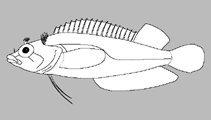
Épines dorsales (Total) : 20 - 21; Rayons mous dorsaux (Total) : 10; Épines anales: 1; Rayons mous anaux: 19; Vertèbres: 35. This species is moderately-sized and with the following characters: moderately elongated body (4.4-5.1 depth in SL); slightly depressed bulbous heed; fleshy lips; posterodorsal corner of maxillary slips into a cheek pouch; nasal, orbital and nuchal cirri small and fimbriate; no scales on breast and belly; scales are membranously expanded posteriorly to form pockets; spinous dorsal fin rays, compared to its soft rays are nearly level, lower and less numerous; only one anal fin spine; interradial membrane of anal fin incised almost up to the base of each ray; unbranched fin rays; convex cornea, eyeball with no vertical bar and heavy pigmentation; conical, stout and slightly recurved teeth; medial teeth of dentary larger than the lateral ones; with vomerine teeth, non on palatine (Ref. 75634).
Cycle de vie et comportement reproducteur
Maturité | Reproduction | Frai | Œufs | Fécondité | Larves
McCosker, J.E., J.S. Stephens and R.H. Rosenblatt, 2003. Cottoclinus canops, a new genus and species of blenny (Perciformes: Labrisomidae) from the Galápagos Islands. Proc. Calif. Acad. Scie. 54(8):155-160. (Ref. 75634)
Statut dans la liste rouge de l'IUCN (Ref. 130435: Version 2025-2 (Global))
Menace pour l'homme
Harmless
Utilisations par l'homme
Outils
Articles particuliers
Télécharger en XML
Sources Internet
Estimations basées sur des modèles
Indice de diversité phylogénétique (Réf.
82804): PD
50 = 1.0000 [Uniqueness, from 0.5 = low to 2.0 = high].
Bayesian length-weight: a=0.00525 (0.00218 - 0.01265), b=3.08 (2.86 - 3.30), in cm total length, based on LWR estimates for this (Sub)family-body shape (Ref.
93245).
Niveau trophique (Réf.
69278): 3.4 ±0.4 se; based on size and trophs of closest relatives
Vulnérabilité de la pêche (Ref.
59153): Low vulnerability (10 of 100).
🛈