>
Gobiiformes (Gobies) >
Gobiidae (Gobies) > Gobiinae
Etymology: Eviota: No etymology given, suggested by Christopher Scharpt: from Latin 'eu' for 'true' and 'iota' for anything very small, in combination 'truly very small' referring to it as being the smallest vertebrate at the time it has benn described by Jenkins (thus, making the suggestion by Scharpt plausible.
Environnement : milieu / zone climatique / profondeur / gamme de distribution
Écologie
marin récifal; profondeur 8 - 15 m (Ref. 90102). Tropical
Eastern Indian Ocean: Christmas Island.
Taille / Poids / Âge
Maturité: Lm ? range ? - ? cm
Max length : 2.1 cm SL mâle / non sexé; (Ref. 81726); 2.1 cm SL (female)
Description synthétique
Clés d'identification | Morphologie | Morphométrie
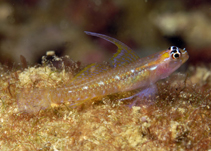
Épines dorsales (Total) : 7; Rayons mous dorsaux (Total) : 9 - 10; Épines anales: 1; Rayons mous anaux: 8 - 9. This species possess the following characters: D VI-I,9-10; A I,8-9; pectoral rays 17-19, pectoral rays 10-19 may be branched, 13-17 always branched except smallest paratype without branched rays; pelvic rays 1,4 1/10 (6) or 1.4 2/10 (1), fourth ray with 6-10 primary branches, averaging 8; with 1 or sometimes 2 segments between consecutive branches of the fourth pelvic-fin ray; well developed pelvic-fin membrane; branched caudal-fin rays 11-13, or 1 damaged; segmented caudal-fin rays 17; lateral scale rows 24 or 25; transverse scale rows 7 or 8; breast naked; naked area of forehead extending posteriorly in a narrow strip along base of dorsal fin. The cephalic pore system conforms with pattern 1 of Lachner and Karnella (1980); very small anterior interorbital pore (AITO); cutaneous papilla system conforms with pattern A of Lachner and Karnella (1980). The first dorsal spine is variable in length, often elongate in adults, extending as far as the caudal peduncle in some individuals, this elongate first dorsal filament is easily damaged and missing in the holotype and some paratypes. Male genital papilla not fimbriate, flattened and relatively elongate with fringe of tiny papillae along distal edge, its maximum length extending slightly beyond origin of anal fin; female papilla short, bulbous, with several finger-like projections, extending to anal spine (Ref. 81726). Dorsal to anal fin-ray formula 9/8 (Ref. 116739).
Body shape (shape guide): elongated; Cross section: oval.
Solitary or loose groups on rubble under overhanging rock in 8-15 m (Ref 90102).
Cycle de vie et comportement reproducteur
Maturité | Reproduction | Frai | Œufs | Fécondité | Larves
Allen, G.R., R.C. Steene and M. Orchard, 2007. Fishes of Christmas Island, Second Edition. Christmas Island Natural History Association, 284 pp. (Ref. 81726)
Statut dans la liste rouge de l'IUCN (Ref. 130435: Version 2025-2 (Global))
Menace pour l'homme
Harmless
Utilisations par l'homme
Outils
Articles particuliers
Télécharger en XML
Sources Internet
Estimations basées sur des modèles
Indice de diversité phylogénétique (Réf.
82804): PD
50 = 0.5000 [Uniqueness, from 0.5 = low to 2.0 = high].
Bayesian length-weight: a=0.00692 (0.00281 - 0.01706), b=3.09 (2.92 - 3.26), in cm total length, based on LWR estimates for this Genus-body shape (Ref.
93245).
Niveau trophique (Réf.
69278): 3.1 ±0.3 se; based on size and trophs of closest relatives
Vulnérabilité de la pêche (Ref.
59153): Low vulnerability (10 of 100).
🛈