Classificação / Nomes
Nomes comuns | Sinónimos | Catalog of Fishes(Género, Espécies) | ITIS | CoL | WoRMS | Cloffa
>
Perciformes/Serranoidei (Groupers) >
Anthiadidae (Fairy basslets or Streamer basses)
Etymology: Plectranthias: Bleeker (1873) disagrees with the generic placement of Plectropoma anthioides by Günther. He, therefore, erected Plectranthias to accommodate Pl. anthioides. The name is presumably the combination of the first part of Plectropoma (plectrum), and anthias. Plectrum = Plektron = πλῆκτρον (Greek, plektron = anyhting to strike with, spur + Greek, anthias = a fish, Ref. 45335); elaine: Named for Elaine Heemstra.
Eponymy: Elaine Margaret Heemstra née Lawrence formerly Grant is Scientific Illustrator Emeritus at the South Africa Institute for Aquatic Biodiversity. [...] (Ref. 128868), visit book page.
More on authors: Heemstra & Randall.
Ambiente: milieu / zona climática / intervalo de profundidade / gama de distribuição
Ecologia
marinhas pelagic-neritic; intervalo de profundidade 68 - 114 m (Ref. 81822). Temperate
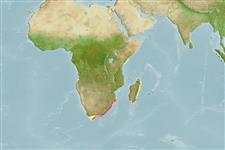
Western Indian Ocean: South Africa.
Tamanho / Peso / Idade
Maturidade: Lm ? range ? - ? cm
Max length : 5.6 cm SL macho/indeterminado; (Ref. 81822)
Descrição breve
Chaves de identificação | Morfologia | Morfometria
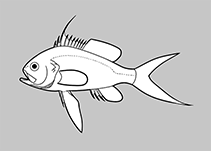
Espinhos dorsais (total) : 10; Raios dorsais moles (total) : 15; Espinhos anais: 3; Raios anais moles: 7. This species has the following characters: color when fresh, dull red on head and body, shading to pale yellow ventrally, bases of median and pectoral fins irregular pale yellow or with white blotches; spinous dorsal fin is pale bluish white, as if daubed with thick paint; upper lip pale, with several red or white vertical bars; iris reddish orange, with short thin radiating blue-grey streaks. D X, 15, the fin margin moderately notched before soft-rayed part, with 3rd spine longest (24-30% SL), 1.8 in head length, short cirrus behind tips of spines 3, 4 and 5; A III,7, with 2nd spine longest, 2nd and 3rd anal-fin rays elongated; pectoral fins 14 rays, all branched except upper and lowermost 2 or 3 rays, fin reaching vertical at 3rd (4th) anal-fin ray; caudal fin slightly emarginate, principal rays 17, branched rays 15, 3 uppermost principal rays slightly produced; pelvic fins not reaching anus. Oval body with depth 2.1-2.5), head length 2.2-2.4, peduncle depth 7.2 (& 7.6) in SL; orbit diameter greater than snout length, 3.8 (3.4), snout length 4.8 (4.4-5.0), bony interorbital width 7.4 (9.8) in head length. Completer lateral-line with 31 (28, 30) tubed scales, 2 rows of large scales between middle dorsal fin spines and lateral-line and 3 scales from dorsal SL; orbit diameter 3.6-3.9, snout length, 4.1-4.8, bony interorbital width 8.0-8.5, all in head length. Lateral line incomplete, ending below middle of soft dorsal fin, with 16-20 tubed scales; 1 row of large scales between 5th dorsal-fin spine and lateral-line; circum-peduncular scales 12; scales on top of head extend to rear nostrils; operculum scaly, with 5-7 oblique series of large scales on cheek and a series along interopercle; snout suborbitals and lower jaw naked. Maxilla reaches past vertical at rear edge of eye; a row of 7-11 small ctenoid scales along (below) dorsal ledge of maxilla. Preopercle edge with 14-20 coarse serrae posteriorly; no antrorse spine on lower edge; subopercle and interopercle with 7-9 coarse serrae. Gill-rakers 4-5 / 9-11. Two supraneural bones, /0+0/2/1+1/1/1/ (Ref. 81822).
Body shape (shape guide): elongated.
Ciclo de vida e comportamento de acasalamento
Maturidade | Reprodução | Desova | Ovos | Fecundidade | Larvas
Heemstra, P.C. and J.E. Randall, 2009. A review of the anthiine fish genus Plectranthias (Perciformes: Serranidae) of the Western Indian Ocean, with description of a new species, and a key to the species. Smithiana Bull. 10:3-17. (Ref. 81822)
Categoria na Lista Vermelha da IUCN (Ref. 130435: Version 2025-2 (Global))
Ameaça para o homem
Harmless
Utilização humana
Pescarias: sem interesse
Ferramentas
Relatórios especiais
Descarregue XML
Fontes da internet
Estimativas baseadas em modelos
Temperatura preferida (Ref.
123201): 13 - 23.1, mean 20.7 °C (based on 9 cells).
Índice de diversidade filogenética (Ref.
82804): PD
50 = 0.5000 [Uniqueness, from 0.5 = low to 2.0 = high].
Bayesian length-weight: a=0.00389 (0.00180 - 0.00842), b=3.12 (2.94 - 3.30), in cm total length, based on all LWR estimates for this body shape (Ref.
93245).
Nível Trófico (Ref.
69278): 3.5 ±0.6 se; based on size and trophs of closest relatives
Resiliência (Ref.
120179): Elevada, tempo mínimo de duplicação da população menor que 15 meses (Preliminary K or Fecundity.).
Vulnerabilidade da pesca (Ref.
59153): Low vulnerability (10 of 100).
🛈