>
Anabantiformes (Gouramies, snakeheads) >
Osphronemidae (Gouramies) > Macropodusinae
Etymology: Betta: Malay/Javanese origin. Bleeker (1850, 1858) indicates Ikan Wadder Bettah as the local name of Betta trifasciata Bleeker, 1849 (now Betta picta, Valenciennes, 1846) in the Ambarawa Javanese dialect. Ikan Wader is a common Javanese name for smaller freshwater fishes, especially cyprinids (already used in Old Javanese). See Blust, R. & Trussel, S. Austronesian Comparative Dictionary. Web Edition (https://www.trussel2.com/acd/); midas: The specific epithet is an allusion to the Greek Midas, a mythical king whose touch turned everything to gold, arising from the iridescent gold opercle and body scales. A noun in apposition.
Eponymy: In Greek mythology, Midas was a king of Phrygia whose touch could turn anything to gold (a gift from the gods which had to be renounced once the impracticalities sunk in). The fish are named after him because of their golden coloration. (Ref. 128868), visit book page.
Milieu: milieu / Klimaatzone / Diepte / verspreidingsgebied
Ecologie
; zoet water benthopelagisch; pH range: 4.1 - ?; diepte 0 - 2 m (Ref. 81926). Tropical
Asia: lower Kapuas basin in west Kalimantan, Indonesia; possibly Sambas river basin; and extreme western part of Sarawak, in heathforest streams near the town of Lundu.
Grootte / Gewicht / Leeftijd
Maturiteit: Lm ? range ? - ? cm
Max length : 6.6 cm SL mannelijk / geslacht onbekend; (Ref. 81926)
Korte beschrijving
Determinatiesleutels | Morfologie | Morfometrie
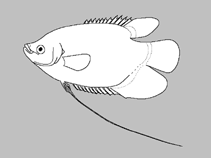
Dorsale stekels (totaal) : 1; Dorsale zachte stralen (totaal) : 8 - 10; Anale stekels: 1 - 2; Anale zachte stralen: 25 - 29; Wervels: 31 - 32. Can be distinguished in possessing the following combination of characters: relatively thick-set body (body depth 24.3-29.0 % SL); head devoid of pattern except for black stripe that runs from black lower lip, through eye to edge of opercle; opercle with gold iridescent scales when live; belly and body with gold iridescent scales; some median caudal rays projecting beyond fin margin (Ref. 81926).
Body shape (shape guide): fusiform / normal.
Facultative air-breathing (Ref. 126274); A paratype series was collected from a blackwater river running through remnant and intact peat swamp forest, with pH 4.1(Ref. 81926).
Levenscyclus en paargedrag
Maturiteit | Voortplanting | Paaien | Eieren | Fecunditeit | Larven
Tan, H.H., 2009. Redescription of Betta anabatoides Bleeker; and a new species of Betta from West Kalimantan, Borneo (Teleostei: Osphronemidae). Zootaxa 2165:59-68. (Ref. 81926)
Status op de Rode Lijst van het IUCN (Ref. 130435: Version 2025-2 (Global))
Gevaar voor de mens
Harmless
Gebruik door de mens
Tools
Speciale rapporten
Download XML
Internetbronnen
Schattingen op basis van modellen
Fylogenetische diversiteitsindex (Ref.
82804): PD
50 = 0.5000 [Uniqueness, from 0.5 = low to 2.0 = high].
Bayesian length-weight: a=0.01000 (0.00374 - 0.02675), b=2.97 (2.74 - 3.20), in cm total length, based on LWR estimates for this (Sub)family-body shape (Ref.
93245).
Trofisch niveau (Ref.
69278): 3.3 ±0.4 se; based on size and trophs of closest relatives
Kwetsbaarheid van de visserij (Ref.
59153): Low vulnerability (10 of 100).
🛈