Classificazione / Nomi
Nomi Comuni | Sinonimi | Catalog of Fishes(Genere, Specie) | ITIS | CoL | WoRMS | Cloffa
>
Siluriformes (Catfishes) >
Cetopsidae (Whale catfishes) > Cetopsinae
Etymology: Cetopsidium: From Cetopsis, the first genus proposed in subfamily Cetopsinae, and 'idium' meaning diminutive, referring to the relatively small body sizes of the members of the genus; soniae: The species name, soniae, is in honor of Dr. Sonia Fisch-Muller of the Muséum d’histoire naturelle, Geneva, who brought the species to our attention, has been of invaluable assistance to both authors with a number of projects over the years, and ha.
Eponymy: Dr Sonia Fisch-Muller is a professor at the Department of Herpetology and Ichthyology, Muséum d’histoire naturelle, Geneva. She co-wrote: Three new species of Ancistrus (2005). She brought Cetopsidium soniae to the authors’ attention. (See also Muller, S) (Ref. 128868), visit book page.
More on authors: Vari & Ferraris.
Ambiente: milieu / zona climatica / distribuzione batimetrica / gamma di distribuzione
Ecologia
; acqua dolce benthopelagico. Tropical
South America: Guyana. Cetopsidium soniae is known from the type locality in the Manari River, a tributary of the Takutu River in the western portions of the rio Branco system of the Amazon basin (Ref. 82380).
Dimensione / Peso / Età
Maturità: Lm ? range ? - ? cm
Max length : 3.1 cm SL maschio/sesso non determinato; (Ref. 82380); 3.6 cm SL (female)
Breve descrizione
Chiavi di identificazione | Morfologia | Morfometria
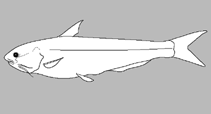
Cetopsidium soniae differs from its congeners in the posterior extent of the pelvic fin (falling distinctly short of the vent versus extending beyond the vent and reaching to the origin of the anal fin in C. minutum (Eigenmann, 1912), and reaching to or slightly beyond the anterior limit of the vent in C. ferreirai Vari, Ferraris & de Pinna, 2005, C. morenoi (Fernández-Yépez, 1972), C. orientale (Vari, Ferraris & Keith, 2003), and C. pemon Vari, Ferraris & de Pinna, 2005, the position of the vent (proximate to the base of the anterior most anal-fin ray versus distinctly anterior to that location in C. roae Vari, Ferraris & de Pinna, 2005), the form of the first rays of the dorsal and pectoral fins (with distal filaments present in males versus without such sexually-dimorphic filaments in C. ferreirai), the orientation of the dorsal and ventral profiles of the postdorsal portion of the body (converging posteriorly versus running in parallel in C. orientale), the distribution of dark pigmentation on the body (with pigmentation distributed across dorsal and lateral surfaces of body versus limited to middorsal region in C. ferreirai), the degree of dark pigmentation on the ventral surface of the lower jaw (with
limited or no pigmentation versus with broad band of pigmentation in C. orientale), the form of the pigmentation on the head and body (chromatophores large and stellate versus small and round in C. minutum and C. pemon), the extent of the pigmentation on the dorsal fin (without any pigmentation or at most several small dark basal spots versus with distinct semicircular dark spot basally in C. morenoi, C. orientale, and
C. pemon), the body depth (0.17-0.18 versus 0.14-0.15 of SL in C. roae), and the form of the head in lateral view (triangular overall but relatively deep posteriorly versus more acutely triangular in C. minutum [see Vari et al., 2005).
Body shape (shape guide): elongated.
Ciclo vitale e comportamento di accoppiamento
Maturità | Riproduzione | Deposizione | Uova | Fecondità | Larve
Vari, R.P. and C.J. Ferraris Jr., 2009. New species of Cetopsidium (Siluriformes: Cetopsidae: Cetopsinae)from the upper rio Branco system in Guyana. Neotrop. Ichthyol. 7(3):289-293. (Ref. 82380)
Stato della Lista Rossa IUCN (Ref. 130435: Version 2025-2 (Global))
Minaccia per l'uomo
Harmless
Usi umani
Strumenti
Rapporti speciali
Scarica XML
Fonti Internet
Stime basate su modelli
Indice di diversità filogenetica (Fonte Biblio.
82804): PD
50 = 0.5078 [Uniqueness, from 0.5 = low to 2.0 = high].
Bayesian length-weight: a=0.00550 (0.00224 - 0.01349), b=3.13 (2.92 - 3.34), in cm total length, based on LWR estimates for this (Sub)family-body shape (Ref.
93245).
Livello trofico (Fonte Biblio.
69278): 3.3 ±0.4 se; based on size and trophs of closest relatives
Vulnerabilità della pesca (Ref.
59153): Low vulnerability (10 of 100).
🛈