Ελασμοβράγχιοι (καρχαρίες και σαλάχια) (sharks and rays) >
Squaliformes (Sleeper and dogfish sharks) >
Centrophoridae (Gulper sharks)
Etymology: Centrophorus: centr[um] (L.), prickle or sharp point; phorus, from phoreus (Gr.), bearer or carrier, referring to grooved spines on dorsal fins (See ETYFish); moluccensis: -ensis, Latin suffix denoting place: Moluccas Islands, Indonesia, type locality (See ETYFish).
More on author: Bleeker.
Περιβάλλον: περιβάλλον / κλιματική ζώνη / εύρος βάθους / εύρος διανομής
Οικολογία
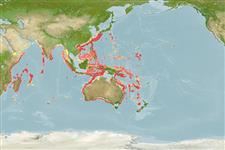
Θαλασσινό(ά) βαθύβιο(ς); εύρος βάθους 125 - 823 m (Ref. 247). Deep-water; 32°N - 40°S, 34°E - 171°E (Ref. 54313)
Indian Ocean: southern Mozambique and off Natal, South Africa (Ref. 5578); India (Ref. 31367). Western Pacific: Japan (Okinawa), Indonesia (Ambon), Philippines (Ref. 31367), Australia, New Hebrides, and New Caledonia.
Μήκος κατά την πρώτη ωρίμανση / Μέγεθος / Βάρος / Ηλικία
Γεννητική Ωρίμανση: Lm ?, range 80 - ? cm
Max length : 100.0 cm TL αρσενικό/απροσδιόριστο; (Ref. 6871); μεγ. δημοσιευμένο βάρος: 2.4 kg (Ref. 40637)
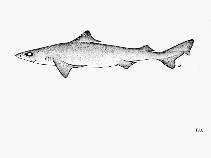
Ραχιαίες άκανθες (συνολικά) : 2; Εδρικές άκανθες: 0. A small, slender gulper shark with a long, narrow snout, a short-based 1st dorsal fin and a very small 2nd dorsal fin; pectoral rear tips elongated; denticles small and flat (Ref. 5578). Grayish brown dorsally, paler ventrally; fin of juveniles dark, with pale edges (Ref. 6577).
Body shape (shape guide): elongated.
Found on the outer continental shelves and upper slopes, on or near the bottom (Ref. 247). Feeds on bony fish, as well as other dogfish sharks, squid, octopus, shrimp, and tunicates (Ref. 247). Ovoviviparous (Ref. 50449). Utilized as fishmeal (Ref. 31367), for its meat, fins (low value) and liver oil (very high value) (Ref.58048).
Ovoviviparous, embryos feed solely on yolk (Ref. 50449). Number of young 2 per litter; size at birth about 31 to 37 cm (Ref. 247); born at 35 cm TL (Ref.58048). Distinct pairing with embrace (Ref. 205).
Compagno, L.J.V., 1984. FAO Species Catalogue. Vol. 4. Sharks of the world. An annotated and illustrated catalogue of shark species known to date. Part 1 - Hexanchiformes to Lamniformes. FAO Fish. Synop. 125(4/1):1-249. Rome, FAO. (Ref. 247)
Κατάσταση Κόκκινου Καταλόγου IUCN (Ref. 130435: Version 2025-2 (Global))
Απειλή για τον άνθρωπο
Harmless
Ανθρώπινες χρήσεις
αλιεία: περιορισμένης εμπορικότητας
Εργαλεία
Ειδικές εκθέσεις
Λήψη XML
Διαδικτυακές πηγές
Εκτιμήσεις βάσει μοντέλων
Προτιμώμενη θερμοκρασία (Αναφ.
123201): 9.3 - 18.5, mean 12.9 °C (based on 246 cells).
Δείκτης φυλογενετικής ποικιλότητας (Αναφ.
82804): PD
50 = 0.5001 [Uniqueness, from 0.5 = low to 2.0 = high].
Bayesian length-weight: a=0.00251 (0.00120 - 0.00527), b=3.19 (3.01 - 3.37), in cm total length, based on LWR estimates for this (Sub)family-body shape (Ref.
93245).
Τροφικό Επίπεδο (Αναφ.
69278): 4.3 ±0.70 se; based on food items.
Ελαστικότητα (Αναφ.
120179): Πολύ χαμηλό, ελάχιστος χρόνος για διπλασιασμό πληθυσμού > 14 έτη (Fec=2).
Ευπάθεια στην αλιεία (Ref.
59153): High vulnerability (60 of 100).
🛈
Θρεπτικά συστατικά (Ref.
124155): Calcium = 7.21 [1.39, 38.02] mg/100g; Iron = 0.313 [0.073, 1.003] mg/100g; Protein = 19.8 [17.5, 22.0] %; Omega3 = 0.287 [0.103, 0.899] g/100g; Selenium = 14.4 [4.6, 42.6] μg/100g; VitaminA = 13.6 [2.9, 63.5] μg/100g; Zinc = 0.29 [0.14, 0.56] mg/100g (wet weight);