การจำแนกประเภท / ชื่อ
ชื่อสามัญ | ชื่อพ้อง | Catalog of Fishes(สกุล, ชนิด) | ITIS | CoL | WoRMS | Cloffa
>
Characiformes (Characins) >
Acestrorhamphidae (American tetras) > Hyphessobryconinae
Etymology: Hyphessobrycon: Greek, hyphesson, -on, -on = a little smaller + Greek, bryko = to bite (Ref. 45335); pando: Named for the region, Departamento Pando, its type locality.
สิ่งแวดล้อม : สิ่งแวดล้อม / เขตภูมิอากาศ / ระดับความลึก / ระยะการกระจายสินค้า
นิเวศวิทยา
; น้ำจืด ผิวน้ำ. Tropical
South America: Bolivia.
ขนาด / น้ำหนัก / อายุ
วัยเจริญพันธุ์: Lm ? range ? - ? cm
Max length : 3.7 cm SL เพศผู้/กระเทย; (Ref. 82662)
คำอธิบายสั้นๆ
เครื่องมือที่ใช้ในการแยกชนิดสัตว์,สิ่งมีชีวิตออกจากกัน | สัณฐานวิทยา | ความยาวต่างๆ
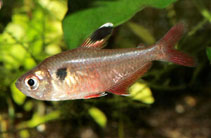
ก้านครีบอ่อนที่หาง (รวม) : 8 - 9; ก้านครีบอ่อนที่ก้น: 22 - 25; สัตว์มีกระดูกสันหลัง: 34. This species is distinguished by the following characters: upper jaw with 2 rows of teeth; no scales on caudal-fin; incomplete lateral line; deep body, red in colour, with a black humeral and dorsal spot, anterior and posterior margined by a light zone. Also characteristic to this species are 6-10 conical to tricuspid teeth on the inner row of the premaxillary; 1-4 conical teeth on the outer row; 5-8 conical to tricuspid teeth on the maxillary; 8 gill rakers on dorsal limb, 13 on ventral; a black dorsal spot converges ventrally to a more or less rounded tip. H. werneri and H. epicharis have similar tooth pattern and a distinct black humeral spot; however, both have a long horizontally extended humeral spot and prolonged dorsal fins in males (vs. a round spot often with small expansions above and below and a short dorsal fin in the H. pando). H. pando differs in having a well developed infraorbital 4 vs. reduced to the laterosensory channel without dermal bones in H. werneri and, white tips of anterior rays of the pelvic and anal fins vs. coloured in H. epicharis (Ref. 82662).
Collected from a blackwater river with no aquatic plants, except for bladderwort Utricularia; pH 5.9 and conductivity of 15 μS/cm (Ref. 82662).
วงจรชีวิตและพฤติกรรมการผสมพันธุ์
วัยเจริญพันธุ์ | การสืบพันธุ์ | การวางไข่ | เซลสืบพันธ์ของเพศเมีย(ไข่) | ความดกของไข่ | ตัวอ่อน
Hein, G., 2009. Hyphessobrycon pando sp. n., a new rosy tetra from northern Bolivia (Teleostei, Characiformes, Characidae). Bull. Fish Biol. 10:1-10. (Ref. 82662)
สถานะบัญชีแดงของ IUCN (Ref. 130435: Version 2025-2 (Global))
ภัยคุกคามต่อมนุษย์
Harmless
การใช้ของมนุษย์
เครื่องมือ
รายงานพิเศษ
ดาวน์โหลด XML
แหล่งที่มาจากอินเตอร์เน็ต
การประมาณค่าตามแบบจำลอง
ดัชนีความหลากหลายทางวิวัฒนาการ (อ้างอิง
82804): PD
50 = 0.5000 [Uniqueness, from 0.5 = low to 2.0 = high].
Bayesian length-weight: a=0.01995 (0.00906 - 0.04395), b=3.01 (2.83 - 3.19), in cm total length, based on all LWR estimates for this body shape (Ref.
93245).
ระดับชั้นอาหาร (อ้างอิง
69278): 2.9 ±0.3 se; based on size and trophs of closest relatives
ความเสี่ยงต่อการตกปลา (Ref.
59153): Low vulnerability (10 of 100).
🛈