分類 / 名稱
俗名 | 同種異名 | Catalog of Fishes(屬, 種) | ITIS | CoL | WoRMS | Cloffa
Teleostei >
Cyprinodontiformes (Rivulines, killifishes and live bearers)
鱂形目 (Rivulines, killifishes and live bearers) >
Poeciliidae (Poeciliids)
花鱂科 (Poeciliids) > Poeciliinae
Etymology: Poecilia: Greek, poikilos = with a lot of colours (Ref. 45335); obscura: The name of the new species is derived from the latin word obscurus (hidden) because of its status as a cryptic species.
環境: 環境 / 氣候帶 / 深度上下限 / 配送範圍
生態學
; 淡水 居於水底的. ; 11°N - 10°N
分布
領土 | FAO區域 | 生態系 | 發現紀錄 | 分布圖 | 簡介 | Faunafri
Western Trinidad, Oropuche River (Ref. 82825).
大小 / 重量 / 年齡
成熟度: Lm ? range ? - ? cm
Max length : 1.5 cm SL 雄魚/尚未辨別雌雄; (Ref. 82825)
簡短描述
檢索表 | 型態特徵 | 形態測量圖
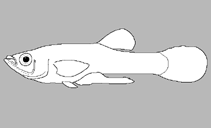
Poecilia obscura is a small poeciliid species from the subgenus Acanthophacelus (SL in males usually not exceeding 20 mm and in females 30 mm), which is distinguished
from all other species of the subgenus by the following characters: comb-like spines of gonopodium ray 3 not numerous (11 to 15), basal massive, vs. numerous (14 to 18), basal slender in P. reticulata and P. wingei. Being genetically divergent from the other species of the subgenus, the definition of the new species is mainly based on evidence from DNA sequence (Ref. 82825).
Body shape (shape guide): fusiform / normal.
生命週期和交配行為
成熟度 | 繁殖 | 產卵場 | 卵 | 孕卵數 | 仔魚
Schories, S., M.K. Meyer and M. Schartl, 2009. Description of Poecilia (Acanthophacelus) obscura n. sp., (Teleostei: Poeciliidae), a new guppy species from eastern Trinidad, with remarks on P. wingei and the status of the (Endler’s guppy). Zootaxa 2266:35-50. (Ref. 82825)
IUCN 瀕危狀態 (Ref. 130435: Version 2025-2 (Global))
人類使用
工具
特別的報告
下載 XML
網路資源
基於模型的估計
系統發育多樣性指數 (參考文獻
82804): PD
50 = 0.5000 [Uniqueness, from 0.5 = low to 2.0 = high].
Bayesian length-weight: a=0.01288 (0.00551 - 0.03009), b=3.14 (2.96 - 3.32), in cm total length, based on LWR estimates for this Genus-body shape (Ref.
93245).
營養階層 (參考文獻
69278): 3.0 ±0.3 se; based on size and trophs of closest relatives
釣魚的脆弱性 (Ref.
59153): Low vulnerability (10 of 100).
🛈