Classificazione / Nomi
Nomi Comuni | Sinonimi | Catalog of Fishes(Genere, Specie) | ITIS | CoL | WoRMS | Cloffa
>
Gobiiformes (Gobies) >
Gobiidae (Gobies) > Gobiinae
Etymology: Amblyeleotris: Greek, amblys = darkness + The name of a Nile fish, eleotris (Ref. 45335); neglecta: Named for the fact that this species was collected and photographed 34 years ago but recognized as new only recently.
More on authors: Jaafar & Randall.
Ambiente: milieu / zona climatica / distribuzione batimetrica / gamma di distribuzione
Ecologia
marino benthopelagico; distribuzione batimetrica 15 - 34 m (Ref. 82599). Tropical
Western Indian Ocean: Gulf of Aqaba, Red Sea.
Dimensione / Peso / Età
Maturità: Lm ? range ? - ? cm
Max length : 3.4 cm SL maschio/sesso non determinato; (Ref. 82599); 5.4 cm SL (female)
Breve descrizione
Chiavi di identificazione | Morfologia | Morfometria
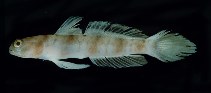
Spine dorsali (totale) : 7; Raggi dorsali molli (totale) : 12 - 14; Spine anali: 1; Raggi anali molli: 13 - 15. This species is distinguished by the following set of characters: D VI + I,12-14; A I,13-15; pectoral fin rays 18-19; pelvic fin rays I, 5, with pelvic fins joined basally by a membrane, pelvic frenum present, fifth pelvic soft fin ray slightly shorter than fourth, branched once mid-ray, branches not separated (occur close together and run parallel to each other throughout the ray); longitudinal scale series 77-85; median predorsal scales 15-17, scales embedded anteriorly, squamation extending to above upper end of preopercular margin; gill opening reaching forward to below middle of opercle; alcohol preserved color beige, with five narrow dark brown bars, broadly bordered in lighter brown, the first from nape across operculum, the last on caudal peduncle; bars progressively less oblique, the last near-vertical; pale interspaces with irregular dark brown line, sometimes branching, often ending dorsally in dark spot; branchiostegal membranes dark brown; caudal fin with dark brown arc at base, limbs of arc narrowing posteriorly to midfin; remaining fins unmarked (Ref. 82599).
Collected in 1974 and 1975 at a depth of 15 m on a sand substratum with patches of the invasive seagrass Halophila stipylacea and occasional small coral heads; in 1986, at 33.5 m, where the substrate consisted of coarse sand and gravel. This species was observed to live in symbiotic association with an alpheid shrimp, but the shrimp was neither collected nor photographed (Ref. 82599).
Ciclo vitale e comportamento di accoppiamento
Maturità | Riproduzione | Deposizione | Uova | Fecondità | Larve
Jaafar, Z. and J.E. Randall, 2009. A pictorial review and key to the shrimp gobies of the genus Amblyeleotris of the Red Sea, with description of a new species. Smithiana Bul. 10:23-29. (Ref. 82599)
Stato della Lista Rossa IUCN (Ref. 130435: Version 2025-2 (Global))
Minaccia per l'uomo
Harmless
Usi umani
Strumenti
Rapporti speciali
Scarica XML
Fonti Internet
Stime basate su modelli
Indice di diversità filogenetica (Fonte Biblio.
82804): PD
50 = 0.5000 [Uniqueness, from 0.5 = low to 2.0 = high].
Bayesian length-weight: a=0.00741 (0.00347 - 0.01582), b=3.09 (2.91 - 3.27), in cm total length, based on LWR estimates for this (Sub)family-body shape (Ref.
93245).
Livello trofico (Fonte Biblio.
69278): 3.2 ±0.3 se; based on size and trophs of closest relatives
Vulnerabilità della pesca (Ref.
59153): Low vulnerability (10 of 100).
🛈