>
Eupercaria/misc (Various families in series Eupercaria) >
Sparidae (Porgies)
Etymology: Acanthopagrus: Greek, akantha = thorn + Greek, pagros, a kind of fish (Ref. 45335).
Eponymy: Hermann Schlegel (1804–1884) was a German-born zoologist who spent much of his life in the Netherlands. [...] (Ref. 128868), visit book page.
More on author: Bleeker.
Milieu: milieu / Klimaatzone / Diepte / verspreidingsgebied
Ecologie
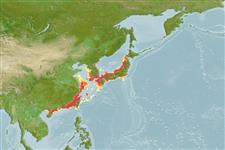
marien; brak water demersaal; diepte 15 - ? m. Subtropical; 43°N - 20°N, 107°W - 143°W
Northwest Pacific: southern Hokkaido, Japan to the southern Korean Peninsula, middle and north coast of the Republic of China and Taiwan. Not occurring in the Ryukyu Islands.
Lengte bij maturiteit / Grootte / Gewicht / Leeftijd
Maturiteit: Lm 29.1, range 10 - ? cm
Max length : 50.0 cm SL mannelijk / geslacht onbekend; (Ref. 559); max. gepubliceerd gewicht: 3.2 kg (Ref. 40637)
Korte beschrijving
Determinatiesleutels | Morfologie | Morfometrie
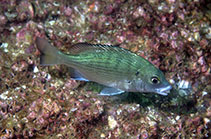
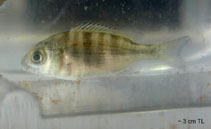
Dorsale stekels (totaal) : 11 - 12; Dorsale zachte stralen (totaal) : 11; Anale stekels: 3; Anale zachte stralen: 8.
Body shape (shape guide): short and / or deep.
Found in bays, shallow rocky reefs, and in brackish waters (Ref. 41299). Feeds on mollusks and polychaetes. Spawns in the spring and summer months (Ref. 41299). It is parasitised by the monogenean A. spari on the fins and body surface (Ref. 124057).
Sex change occurs at about 5 years of age (Ref. 36558).
Masuda, H., K. Amaoka, C. Araga, T. Uyeno and T. Yoshino, 1984. The fishes of the Japanese Archipelago. Vol. 1. Tokai University Press, Tokyo, Japan. 437 p. (text). (Ref. 559)
Status op de Rode Lijst van het IUCN (Ref. 130435: Version 2025-2 (Global))
Gevaar voor de mens
Harmless
Gebruik door de mens
Visserij: commercieel; Aquacultuur: commercieel; sportvis: ja
Tools
Speciale rapporten
Download XML
Internetbronnen
Schattingen op basis van modellen
Gewenste temperatuur (Ref.
123201): 13.1 - 25.4, mean 23.7 °C (based on 68 cells).
Fylogenetische diversiteitsindex (Ref.
82804): PD
50 = 0.5000 [Uniqueness, from 0.5 = low to 2.0 = high].
Bayesian length-weight: a=0.02089 (0.01260 - 0.03464), b=2.99 (2.85 - 3.13), in cm total length, based on LWR estimates for this species & Genus-body shape (Ref.
93245).
Trofisch niveau (Ref.
69278): 3.2 ±0.45 se; based on food items.
Weerstandsvermogen (Ref.
120179): Gemiddeld, minimale populatieverdubbelingstijd 1,4-4,4 jaar (tm=2).
Kwetsbaarheid van de visserij (Ref.
59153): Moderate vulnerability (37 of 100).
🛈
Kwetsbaarheid voor het klimaat (Ref.
125649): Very high vulnerability (81 of 100).
🛈
Voedingsstoffen (Ref.
124155): Calcium = 85.9 [43.0, 149.5] mg/100g; Iron = 1.07 [0.60, 2.18] mg/100g; Protein = 19.5 [18.3, 20.6] %; Omega3 = 0.279 [0.169, 0.478] g/100g; Selenium = 22.2 [10.4, 45.1] μg/100g; VitaminA = 6.4 [1.9, 21.1] μg/100g; Zinc = 0.786 [0.522, 1.168] mg/100g (wet weight);