Classificação / Nomes
Nomes comuns | Sinónimos | Catalog of Fishes(Género, Espécies) | ITIS | CoL | WoRMS | Cloffa
>
Cyprinodontiformes (Rivulines, killifishes and live bearers) >
Nothobranchiidae (African rivulines)
Etymology: Nothobranchius: Greek, nothos = false + Greek, brangchia = gill (Ref. 45335); lucius: Name from Latin meaning pike, alluding to the stronger dentition (compared to its congeners), partly predatory behavior and pike-like appearance.
Ambiente: milieu / zona climática / intervalo de profundidade / gama de distribuição
Ecologia
; Água doce bentopelágico. Tropical
Africa: Kilombero Valley, forming Kibasira Swamp, part of Rufiji River basin, in Tanzania (Ref. 83514, 122074).
Tamanho / Peso / Idade
Maturidade: Lm ? range ? - ? cm
Max length : 5.4 cm SL macho/indeterminado; (Ref. 122074); 5.2 cm SL (female)
Descrição breve
Chaves de identificação | Morfologia | Morfometria
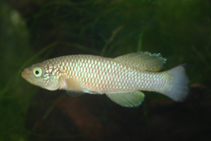
Espinhos dorsais (total) : 0; Raios dorsais moles (total) : 14 - 16; Espinhos anais: 0; Raios anais moles: 16 - 18. Diagnosis: Nothobranchius lucius differs from all other species of the N. melanospilus group, except N. insularis, by having snout pointed in lateral view, jaws moderately long vs. snout blunt to weakly pointed, jaws short; caudal fin, in males, with broad dark grey to black band on the posterior margin vs. narrow; presence, in females, of dark dots over the whole flank vs. dark dots when present restricted to the posterior portion of the flank (Ref. 122074). It is distinguished from N. insularis by having inner premaxillary teeth larger than teeth of the outer premaxillary tooth row vs. smaller; caudal fin rounded in males vs. subtruncate; in females, flank dark dots are rounded and arranged in horizontal rows vs. dots vertically elongated, often arranged in oblique rows; unpaired fins, in females, with dark grey dots extending over most fin vs. dots restricted to the basal portion of unpaired fins; caudal, pectoral and pelvic fins longer, caudal fin length in males 31.3-34.9% of standard length and 30.3-32.9% of standard length in females of N. lucius, vs. 26.9-29.6% of standard length in males and 22.8-27.4% of standard length in females of N. insularis; pectoral-fin length 22.2-24.5% of standard length in males and 20.2-24.6% of standard length in females, vs. 17.1-21.8% of standard length and 14.2-19.3% of standard length, respectively; pelvic-fin length 11.6-13.1% of standard length in males and 11.5-13.0% of standard length in females, vs. 8.6-11.0% of standard length and 9.6-11.0% of standard length, respectively; and two neuromasts in the posterior section of the anterior supraorbital series vs. three (Ref. 122074).
Body shape (shape guide): fusiform / normal; Cross section: compressed.
Found in seasonal pools and swamps and has an annual mode of reproduction; observations on captive specimens indicate that it can be predatory to smaller fish, although this behavior is not obligatory (Ref. 83514).
Ciclo de vida e comportamento de acasalamento
Maturidade | Reprodução | Desova | Ovos | Fecundidade | Larvas
Costa, W.J.E.M., 2017. Redescription of Nothobranchius lucius and description of a new species from Mafia Island, eastern Tanzania (Cyprinodontiformes, Aplocheilidae). Zoosyst. Evol. 93(1):35-44. (Ref. 122074)
Categoria na Lista Vermelha da IUCN (Ref. 130435: Version 2025-2 (Global))
Ameaça para o homem
Harmless
Utilização humana
Ferramentas
Relatórios especiais
Descarregue XML
Fontes da internet
Estimativas baseadas em modelos
Índice de diversidade filogenética (Ref.
82804): PD
50 = 0.5000 [Uniqueness, from 0.5 = low to 2.0 = high].
Bayesian length-weight: a=0.01096 (0.00461 - 0.02608), b=2.94 (2.74 - 3.14), in cm total length, based on LWR estimates for this (Sub)family-body shape (Ref.
93245).
Nível Trófico (Ref.
69278): 3.2 ±0.4 se; based on size and trophs of closest relatives
Vulnerabilidade da pesca (Ref.
59153): Low vulnerability (10 of 100).
🛈