Classification / Noms
Noms communs | Synonymes | Catalog of Fishes(Genre, Espèce) | ITIS | CoL | WoRMS | Cloffa
>
Lophiiformes (Anglerfishes) >
Tetrabrachiidae (Four-armed frogfishes)
Etymology: Dibrachichthys: Name from Greek 'di' meaning two; 'brachion' for arm; and 'ichthys' for fish, in allusion to the two pectoral fins, one on each side, in contrast to the ‘‘double’’ pectoral fin (two on each side) of its sister genus Tetrabrachium; melanurus: Name derived from the Greek 'melanos' for black and 'oura' for tail, referring to the conspicuous black bar across the base of the caudal fin.
Environnement : milieu / zone climatique / profondeur / gamme de distribution
Écologie
marin pelagic-neritic; profondeur 6 - 146 m (Ref. 82431). Tropical
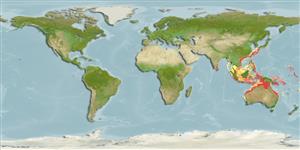
Eastern Indian Ocean to Western Pacific: Australia and Indonesia.
Taille / Poids / Âge
Maturité: Lm ? range ? - ? cm
Max length : 5.7 cm SL mâle / non sexé; (Ref. 82431); 5.6 cm SL (female)
Description synthétique
Clés d'identification | Morphologie | Morphométrie
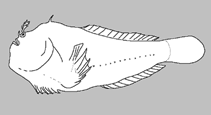
Rayons mous dorsaux (Total) : 14 - 15; Rayons mous anaux: 8 - 10; Vertèbres: 21. This species is distinguished by the following characters: pectoral fin entire rather than the rays divided into two distinct sections; considerably broader cranium, with more extensive lateral projections of the lateral ethmoids, sphenotics, and pterotics; frontals highly elevated, each with a prominent medial flange closely approaching its counterpart on the midline (forming a longitudinal, semi-closed, tube-like structure on the snout between the eyes), and a large anterolateral surface, forming (together with the respective sphenotic and lateral ethmoid) a deep, semi-circular, protective cavity for the eye; parietals conical and highly elevated, resulting in formation of a deep, central, cranial depression; vertebrae 21; posteriormost proximal radial of the dorsal and anal fins lying between the neural and haemal spines, respectively, of the fifth and sixth pre-ural centra; second and third dorsal-fin spines well developed; dorsal-fin rays 14-15; anal-fin rays 8-10; distal end of the third pectoral-fin radial relatively small; considerably longer pectoral-fin rays with longest ray 34.5-48.5%; pelvic bone and fin hypertrophied; an entirely different pigment pattern; oral cavity darkly pigmented; a conspicuous dark band on the dorsum just below the soft dorsal fin, a dark bar across the caudal peduncle and base of the tail, no ocelli-like spots (Ref. 82431).
Specimens collected by epibenthic sled, dredge, otter trawl or prawn trawl over soft-bottom substrates of mud or sand. Apparently rare, with solitary individuals widely dispersed. (Ref. 82431).
Cycle de vie et comportement reproducteur
Maturité | Reproduction | Frai | Œufs | Fécondité | Larves
Pietsch, T.W., J.W. Johnson and R.J. Arnold, 2009. A new genus and species of the shallow-water anglerfish family Tetrabrachiidae (Teleostei: Lophiiformes: Antennarioidei) from Australia and Indonesia. Copeia 2009(3):483-493. (Ref. 82431)
Statut dans la liste rouge de l'IUCN (Ref. 130435: Version 2025-2 (Global))
Menace pour l'homme
Harmless
Utilisations par l'homme
Outils
Articles particuliers
Télécharger en XML
Sources Internet
Estimations basées sur des modèles
Température préférée (Réf.
123201): 23.3 - 28.3, mean 27 °C (based on 331 cells).
Indice de diversité phylogénétique (Réf.
82804): PD
50 = 1.2500 [Uniqueness, from 0.5 = low to 2.0 = high].
Bayesian length-weight: a=0.01995 (0.00906 - 0.04395), b=3.01 (2.83 - 3.19), in cm total length, based on all LWR estimates for this body shape (Ref.
93245).
Niveau trophique (Réf.
69278): 3.5 ±0.5 se; based on size and trophs of closest relatives
Vulnérabilité de la pêche (Ref.
59153): Low vulnerability (10 of 100).
🛈