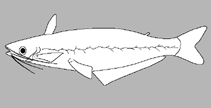
Ταξινόμηση / Ονόματα
Κοινά ονόματα | Συνώνυμα | Catalog of Fishes(Γένος, Είδη) | ITIS | CoL | WoRMS | Cloffa
>
Siluriformes (Catfishes) >
Auchenipteridae (Driftwood catfishes) > Auchenipterinae
Etymology: Tetranematichthys: Greek, tetra = four + Greek, nema = filament + Greek, ichthys = fish (Ref. 45335); barthemi: Named for Ronaldo Borges Barthem, a researcher of the MPEG, for his
contribution to the field of ichthyology, in particular to fisheries ecology in the Amazon.
Eponymy: Dr Ronaldo Borges Barthem is a marine biologist and ichthyologist. [...] (Ref. 128868), visit book page.
Περιβάλλον: περιβάλλον / κλιματική ζώνη / εύρος βάθους / εύρος διανομής
Οικολογία
; Γλυκού νερού βενθικό(ς). Tropical
South America: Lower Amazon, between the mouth of the rio Negro and the mouth of the rio Trombetas in Brazil.
Μέγεθος / Βάρος / Ηλικία
Γεννητική Ωρίμανση: Lm ? range ? - ? cm
Max length : 17.6 cm SL αρσενικό/απροσδιόριστο; (Ref. 83952)
Σύντομη περιγραφή
Κλείδες προσδιορισμού | Μορφολογία | Μορφομετρία
This species is distinguished from T. wallacei and T. quadrifilis by the following: with a serrated margin on the distal portion of the mandibular barbel (vs. presence of conspicuous digitiform elaboration); length of mandibular barbel, 4.5-6.0% HL (vs. 6.3-23.5% in quadrifilis and 7.4-24.6% in wallacei); with a pale ventral region with sparse chromatophores (vs. uniformly brown with darkened spots); a large pale stripe, more evident in females, immediately above the lateral line, extending from the humeral region to the transverse line above the end of the adipose fin (vs. narrow pale stripe in both sexes or absent); presence of irregular patches, which can form a pale distinct stripe in the medial portion of the pelvic fin (vs. uniform dark pigmentation ); no darkened spots on the anal fin in females (vs. presence in both sexes); absence of irregular dark patches along the body (vs. patches present); with 2 pale distinct vertical stripes on the caudal fin in specimens over 160 mm SL (vs. only irregular patches or vertical stripe followed by irregular patches); further differs from T. wallacei by the small size of the snout, 28.8-34.5% HL (vs. 41.2-49.3%) and the width of the body at the insertion of the pectoral fin, 82.1-88.7% HL (vs. 69.2-79.3%); further differs from T. quadrifilis by the reduced size of principal unbranched ray of the upper caudal-fin lobe, 15.6-16.9% SL (vs. 18.1-19.9%), length of head, 24.4-28.2% SL (vs. 28.5-32.3%); width of the body at the insertion of the pectoral fin, 91.6-111.3% HO (vs. 117.0-125.0%) (Ref. 83952).
Κύκλος ζωής και συμπεριφορά ζευγαρώματος
Γεννητική Ωρίμανση | Αναπαραγωγή | Γεννοβολία | Αβγά | Γονιμότητα | Προνύμφες
Peixoto, L.A.W. and W.B. Wosiacki, 2010. Description of a new species of Tetranematichthys (Siluriformes: Auchenipteridae) from the lower Amazon basin, Brazil. Neotrop. Ichthyol. 8(1):69-75. (Ref. 83952)
Κατάσταση Κόκκινου Καταλόγου IUCN (Ref. 130435: Version 2025-2 (Global))
Απειλή για τον άνθρωπο
Harmless
Ανθρώπινες χρήσεις
Εργαλεία
Ειδικές εκθέσεις
Λήψη XML
Διαδικτυακές πηγές
Εκτιμήσεις βάσει μοντέλων
Δείκτης φυλογενετικής ποικιλότητας (Αναφ.
82804): PD
50 = 0.6250 [Uniqueness, from 0.5 = low to 2.0 = high].
Bayesian length-weight: a=0.00871 (0.00408 - 0.01859), b=3.03 (2.85 - 3.21), in cm total length, based on LWR estimates for this (Sub)family-body shape (Ref.
93245).
Τροφικό Επίπεδο (Αναφ.
69278): 3.4 ±0.4 se; based on size and trophs of closest relatives
Ελαστικότητα (Αναφ.
120179): Υψηλό, ελάχιστος χρόνος για διπλασιασμό πληθυσμού < 15 μήνες (Preliminary K or Fecundity.).
Ευπάθεια στην αλιεία (Ref.
59153): Low vulnerability (11 of 100).
🛈