>
Mulliformes (Goatfishes) >
Mullidae (Goatfishes)
Etymology: Upeneus: Greek, ypene, -es = upper lip (Ref. 45335); supravittatus: Named for the high gill-raker count and the long pectoral-fin length, which in combination place this species 'above' all other species of the vittatus group.
Taxonomic Remarks
FishBase common name changed from Long-fin goatfish to Longfin goatfish (Uiblein et al., 2024: Ref. 130857).
Environnement : milieu / zone climatique / profondeur / gamme de distribution
Écologie
marin récifal; profondeur ? - 40 m (Ref. 83903). Tropical
Eastern Indian Ocean: Sri Lanka, southern India.
Taille / Poids / Âge
Maturité: Lm ? range ? - ? cm
Max length : 14.0 cm SL mâle / non sexé; (Ref. 83903)
Description synthétique
Clés d'identification | Morphologie | Morphométrie
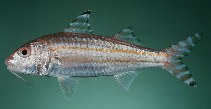
Épines dorsales (Total) : 8; Rayons mous dorsaux (Total) : 9. This species is distinguished by the following characters: D VIII,9; pectoral fins 16-17; gill rakers 7-9 + 21-23 = 28-32; lateral line scales 34-36; body depth at first dorsal fin origin 26-30% SL and at anal-fin origin 22-25% SL; caudal-peduncle depth 9.9-11% SL; maximum head depth 23-26% SL; head depth through eye 17-20% SL; head length 30-33%SL; orbit length 6.8-8.5% SL; upper jaw length 12-14% SL; barbel length 19-23% SL; caudal-fin length 27-31% SL; anal-fin height 14-17% SL; pelvic-fin length 18-21% SL; pectoral-fin length 25-28% SL; first dorsal-fin height 23-26% SL; second dorsal-fin height 15-17% SL; 8-10 total bars on caudal fin, 4-6 brown bars on upper caudal-fin lobe, 3-5 of same color on lower lobe with the 3 proximal bars on upper lobe strongly curved and the 2 proximal bars on lower lobe slightly curved, with pale interspaces between bars are of nearly equal width on both lobes, and narrower than bars; in adult specimens, lower lobe often considerably shortened with only 3 bars, and the distal-most one increased in size; on preserved fish bars are retained. Fresh fish with 2 lateral body stripes, one pale-brown mid-lateral stripe reaching from behind head to caudal-fin base, and one below of same color, from pectoral-fin base to caudal-fin base; tip of first dorsal-fin dark as in preserved fish; head and body brassy to silvery grey, light rose laterally and slightly darker dorsally, belly pale in fresh fish; body and head uniformly brown or dorsally darkened in preserved fish (Ref. 83903).
Body shape (shape guide): fusiform / normal.
Cycle de vie et comportement reproducteur
Maturité | Reproduction | Frai | Œufs | Fécondité | Larves
Uiblein, F. and P.C. Heemstra, 2010. A taxonomic review of the Western Indian Ocean goatfishes of the genus Upeneus (Family Mullidae), with descriptions of four new species. Smithiana 11:35-71. (Ref. 83903)
Statut dans la liste rouge de l'IUCN (Ref. 130435: Version 2025-2 (Global))
Menace pour l'homme
Harmless
Utilisations par l'homme
Outils
Articles particuliers
Télécharger en XML
Sources Internet
Estimations basées sur des modèles
Indice de diversité phylogénétique (Réf.
82804): PD
50 = 0.5000 [Uniqueness, from 0.5 = low to 2.0 = high].
Bayesian length-weight: a=0.00933 (0.00439 - 0.01983), b=3.09 (2.92 - 3.26), in cm total length, based on LWR estimates for this Genus-body shape (Ref.
93245).
Niveau trophique (Réf.
69278): 3.4 ±0.4 se; based on size and trophs of closest relatives
Résilience (Réf.
120179): Haut, temps minimum de doublement de population inférieur à 15 mois (Preliminary K or Fecundity.).
Vulnérabilité de la pêche (Ref.
59153): Low vulnerability (10 of 100).
🛈