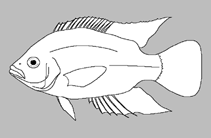
Classification / Noms
Noms communs | Synonymes | Catalog of Fishes(Genre, Espèce) | ITIS | CoL | WoRMS | Cloffa
>
Cichliformes (Cichlids, convict blennies) >
Cichlidae (Cichlids) > Geophaginae
Etymology: Geophagus: Greek, gea = the earth + Greek, phagein = to eat (Ref. 45335); sveni: The specific name sveni is a patronym for Sven Kullander, in recognition of his many contributions to Cichlid Systematics (Ref. 84008).
Environnement : milieu / zone climatique / profondeur / gamme de distribution
Écologie
; eau douce démersal. Tropical; 9°S - 11°S, 48°W - 49°W
South America: Brazil. Known from the middle portions of the Rio Tocantins drainage (Ref. 84008).
Taille / Poids / Âge
Maturité: Lm ? range ? - ? cm
Max length : 16.7 cm SL mâle / non sexé; (Ref. 84008)
Description synthétique
Clés d'identification | Morphologie | Morphométrie
The lack of head markings distinguishes Geophagus sveni from G. grammepareius, G. taeniopareius, G. harreri, G. argyrostictus, and G. gottwaldi which have a complete infra-orbital stripe, and from G. dicrozoster, G. winemilleri, G. brachybranchus, and G. proximus, which have a black preopercular marking. Preserved specimens of Geophagus sveni can be distinguished from all other Geophagus species without head markings (except G. parnaibae) by the possession of five faint vertical, parallel bars on the flank (vs. absent in G. megasema, G. camopiensis and G. altifrons; four in G. surinamensis, and six in G. abalios and G. brokopondo). Geophagus sveni can be distinguished from by its lateral bars (solid bars vs. second and third bars medially bisected by a clearer area, respectively) and the colour pattern of the caudal
fin, which is composed by alternating vertical light and dark bars (vs. alternating horizontal light and dark bars in G. parnaibae). The prominent mid-lateral blotch occupying rostro-caudally five or six scales width and reaching the row immediately above the upper lateral line distinguishes G. sveni from G. abalios, G. surinamensis, G. altifrons, and G. brokopondo. Geophagus sveni can be distinguished from G. camopiensis by the rounded mid-lateral blotch (vs. quadrate-like). Geophagus sveni differs from the sympatric and syntopic Geophagus neambi by the presence of five faint vertically bars (vs. seven or eight conspicuous dorso-ventral bifurcated vertically bars); live specimens with anterior portions of horizontal stripes conspicuously reddish and posterior portions orange (vs. anterior portions slightly more orange than the posterior portions) and three iridescent blue vertical spots present extending along the preopercle (vs. iridescent blue spots absent) (Ref. 84008).
Cycle de vie et comportement reproducteur
Maturité | Reproduction | Frai | Œufs | Fécondité | Larves
Lucinda, P.H.F., C.A.S. Lucena and N.C. Assis, 2010. Two new species of cichlid fish genus Geophagus Heckel from the Rio Tocantins drainage (Perciformes: Cichlidae). Zootaxa 2429:29-42. (Ref. 84008)
Statut dans la liste rouge de l'IUCN (Ref. 130435: Version 2025-2 (Global))
Menace pour l'homme
Harmless
Utilisations par l'homme
Outils
Articles particuliers
Télécharger en XML
Sources Internet
Estimations basées sur des modèles
Indice de diversité phylogénétique (Réf.
82804): PD
50 = 0.5000 [Uniqueness, from 0.5 = low to 2.0 = high].
Bayesian length-weight: a=0.02399 (0.01144 - 0.05029), b=3.01 (2.83 - 3.19), in cm total length, based on LWR estimates for this (Sub)family-body shape (Ref.
93245).
Niveau trophique (Réf.
69278): 2.3 ±0.1 se; based on size and trophs of closest relatives
Résilience (Réf.
120179): Haut, temps minimum de doublement de population inférieur à 15 mois (Preliminary K or Fecundity.).
Vulnérabilité de la pêche (Ref.
59153): Low vulnerability (10 of 100).
🛈
Nutriments (Ref.
124155): Calcium = 231 [132, 483] mg/100g; Iron = 2.04 [1.13, 4.05] mg/100g; Protein = 18.6 [17.2, 20.1] %; Omega3 = 0.504 [0.190, 1.422] g/100g; Selenium = 61.2 [26.7, 159.8] μg/100g; VitaminA = 38.2 [9.8, 106.6] μg/100g; Zinc = 2.43 [1.58, 3.82] mg/100g (wet weight);