>
Gobiiformes (Gobies) >
Gobiidae (Gobies) > Gobiinae
Etymology: Ancistrogobius: Name from Greek word 'agkistros' meaning fishhook and Gobius , a genus name of gobiine fish, in reference to the short, ventrally directed, spur-like preopercular spine; yoshigoui: Named for H. Yoshigou, who provided five paratypes and valuable information about this species.
Eponymy: Hidenori Yoshigou is (1998–present) a research zoologist and systematist with the environmental company, Chugai Technos, Hiroshima, Japan. [...] (Ref. 128868), visit book page.
Environnement : milieu / zone climatique / profondeur / gamme de distribution
Écologie
marin benthopélagique; profondeur 5 - 30 m (Ref. 84001). Subtropical
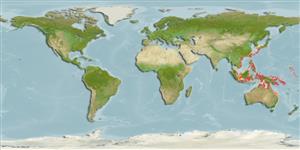
Western Pacific: Japan, Philippines, Indonesia and Papua New Guinea.
Taille / Poids / Âge
Maturité: Lm ? range ? - ? cm
Max length : 4.1 cm SL mâle / non sexé; (Ref. 84001)
Description synthétique
Clés d'identification | Morphologie | Morphométrie
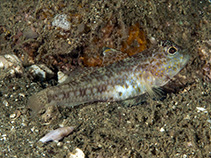
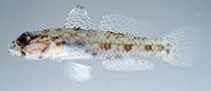
Épines dorsales (Total) : 7; Rayons mous dorsaux (Total) : 9 - 10; Épines anales: 1; Rayons mous anaux: 9. This species is unique from its congeners by having the following characters: lacks a filamentous spine on the first dorsal fin (the third spine subequal in length to preceding spine); 19-20, typically 20 pectoral-fin rays; head and most of nape no scales, predorsal scales absent; pelvic fins fused medially with well developed connecting membrane and frenum; fifth segmented ray of pelvic fin 91.8-94.9% of preceding ray in length; below the eye faint, dusky blotches (not forming vertical bar); distal tip of first dorsal fin with a black blotch, wide, extending posteriorly to middle or more posterior part of third interspinal membrane; sensory papilla rows x^1 and x^2 not continuous, interrupted by row trp; sensory papilla rows trp extending dorsally to slightly above a longitudinal line through rows x^1 + x^2; anterior tip of sensory papilla row b extending or not to row 4 and well apart from row (Ref. 84001).
Body shape (shape guide): elongated; Cross section: oval.
Collected from sandy-mud or silt bottoms at depths of 5-30 m (Ref. 84001).
Cycle de vie et comportement reproducteur
Maturité | Reproduction | Frai | Œufs | Fécondité | Larves
Shibukawa, K., T. Yoshino and G.R. Allen, 2010. Ancistrogobius, a new cheek-spine goby genus from the West Pacific and Red Sea, with descriptions of four new species (Perciformes: Gobiidae: Gobiinae). Bull. Natl. Mus. Nat. Sci., Ser. A, (Suppl. 4):67-87. (Ref. 84001)
Statut dans la liste rouge de l'IUCN (Ref. 130435: Version 2025-2 (Global))
Menace pour l'homme
Harmless
Utilisations par l'homme
Outils
Articles particuliers
Télécharger en XML
Sources Internet
Estimations basées sur des modèles
Température préférée (Réf.
123201): 25.4 - 29.3, mean 28.7 °C (based on 903 cells).
Indice de diversité phylogénétique (Réf.
82804): PD
50 = 0.5625 [Uniqueness, from 0.5 = low to 2.0 = high].
Bayesian length-weight: a=0.00741 (0.00347 - 0.01582), b=3.09 (2.91 - 3.27), in cm total length, based on LWR estimates for this (Sub)family-body shape (Ref.
93245).
Niveau trophique (Réf.
69278): 3.2 ±0.3 se; based on size and trophs of closest relatives
Résilience (Réf.
120179): Haut, temps minimum de doublement de population inférieur à 15 mois (Preliminary K or Fecundity.).
Vulnérabilité de la pêche (Ref.
59153): Low vulnerability (10 of 100).
🛈