การจำแนกประเภท / ชื่อ
ชื่อสามัญ | ชื่อพ้อง | Catalog of Fishes(สกุล, ชนิด) | ITIS | CoL | WoRMS | Cloffa
>
Argentiniformes (Marine smelts) >
Argentinidae (Argentines or herring smelts)
Etymology: Glossanodon: Greek, glossa = tongue + Greek, anodos = without teeth (Ref. 45335); kotakamaru: Named for the National Research Institute of Fisheries Science research vessel Kotaka-maru, from which the paratypes and many other scientific specimens from Tosa Bay were collected.
Eponymy: This species is named after the Research Vessel ‘Kotaka-maru’ which belonged to the National Research Institute of Fisheries Science, Kochi, Japan. [...] (Ref. 128868), visit book page.
สิ่งแวดล้อม : สิ่งแวดล้อม / เขตภูมิอากาศ / ระดับความลึก / ระยะการกระจายสินค้า
นิเวศวิทยา
เกี่ยวกับทะเล,น้ำเค็ม กลุ่มสัตว์หน้าดิน,กลุ่มสัตว์พื้นท้องน้ำ; ระดับความลึก 146 - 300 m (Ref. 84005). Deep-water
การแพร่กระจาย
อาณาเขต | พื้นที่จำแนกตาม FAO | ระบบนิเวศหลายระบบ | การปรากฏขึ้น,การเกิดขึ้น,พบ | ตำแหน่งบนแผนที่ | การแนะนำ | Faunafri
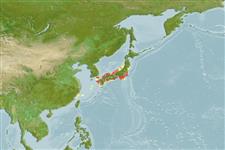
Northwest Pacific: Japan.
ขนาด / น้ำหนัก / อายุ
วัยเจริญพันธุ์: Lm ? range ? - ? cm
Max length : 12.5 cm SL (female)
คำอธิบายสั้นๆ
เครื่องมือที่ใช้ในการแยกชนิดสัตว์,สิ่งมีชีวิตออกจากกัน | สัณฐานวิทยา | ความยาวต่างๆ
ก้านครีบอ่อนที่หาง (รวม) : 12 - 13; ก้านครีบอ่อนที่ก้น: 11 - 13; สัตว์มีกระดูกสันหลัง: 49 - 50. This species is unique in having the following set of characters: D 12-13; A 11-13; pectoral-fin rays 21-23; pelvic-fin rays 13-14; branchiostegal rays 5; gill-rakers on first arch 37-40; vertebrae
49-50; small conical teeth on middle of lower jaws 2-4, teeth on tongue and 1-3; predorsal 48-49% SL; prepectoral 29-30% SL; prepelvic 55-56% SL; distance from pelvic to anal-fin origins 30-31% SL; caudal peduncle depth 5.5-5.9%; HL and 29-30% SL; eye diameter 32-33% HL; snout length 33% HL; maxillary depth 12% HL; anus immediately anterior to anal-fin origin; large black blotches on upper and lower opercular region 2; a black longitudinal stripe running dorsal to lateral line; pigmented isthmus to thorax and fin bases; no melanophores externally on chest to anus (Ref. 84005).
Body shape (shape guide): elongated.
Occurs over muddy and sandy bottoms, at depths of about 150-300 m; young specimens
collected at 146-234 m (Ref. 84005).
วงจรชีวิตและพฤติกรรมการผสมพันธุ์
วัยเจริญพันธุ์ | การสืบพันธุ์ | การวางไข่ | เซลสืบพันธ์ของเพศเมีย(ไข่) | ความดกของไข่ | ตัวอ่อน
Endo, H. and K. Nashida, 2010. Glossanodon kotakamaru, a new Argentine fish from southern Japan (Protacanthopterygii: Argentinidae). Bull. Natl. Mus. Nat. Sci., Ser. A, (Suppl. 4):119-127. (Ref. 84005)
สถานะบัญชีแดงของ IUCN (Ref. 130435: Version 2025-2 (Global))
ภัยคุกคามต่อมนุษย์
Harmless
การใช้ของมนุษย์
เครื่องมือ
รายงานพิเศษ
ดาวน์โหลด XML
แหล่งที่มาจากอินเตอร์เน็ต
การประมาณค่าตามแบบจำลอง
ดัชนีความหลากหลายทางวิวัฒนาการ (อ้างอิง
82804): PD
50 = 0.5000 [Uniqueness, from 0.5 = low to 2.0 = high].
Bayesian length-weight: a=0.00372 (0.00166 - 0.00833), b=3.17 (2.98 - 3.36), in cm total length, based on LWR estimates for this (Sub)family-body shape (Ref.
93245).
ระดับชั้นอาหาร (อ้างอิง
69278): 3.1 ±0.3 se; based on size and trophs of closest relatives
ความสามารถในการกลับคืนสู่ปกติ (อ้างอิง
120179): ความสูง, เวลาต่ำสุดที่จะทำให้ประชากรเพิ่มขึ้นเป็น 2 เท่าใช้เวลาน้อยกว่า 15 เดือน (Preliminary K or Fecundity.).
ความเสี่ยงต่อการตกปลา (Ref.
59153): Low vulnerability (10 of 100).
🛈