>
Lophiiformes (Anglerfishes) >
Ogcocephalidae (Batfishes)
Etymology: Malthopsis: Greek, malthe, es = a marine fish of soft flesh (Ref. 45335); gigas: Name refers to the giant adult body size of the genus (Ref. 84006).
Eponymy: Gigas was a giant in Greek mythology, the child of Uranus and Gaea. The name is applied to taxa that are giants of their kind. (Ref. 128868), visit book page.
Environnement : milieu / zone climatique / profondeur / gamme de distribution
Écologie
marin bathydémersal; profondeur 210 - 650 m (Ref. 123774). Subtropical
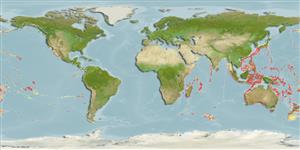
Indo-Pacifc: Madagascar and Somalia to French Polynesia; north to Japan, south to New Zealand.
Taille / Poids / Âge
Maturité: Lm ? range ? - ? cm
Max length : 13.6 cm SL mâle / non sexé; (Ref. 84006)
Description synthétique
Clés d'identification | Morphologie | Morphométrie
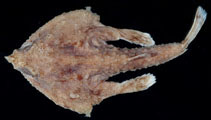
Rayons mous dorsaux (Total) : 5 - 6. This species differs from its congeners in having the following characters: relatively long and strong rostrum (5.2-11.5% SL, x = 8.6% SL); rostral spine directed forward and upward; body heavily covered with strong conical bucklers; numerous small and flat bucklers covering dorsal surface between principal bucklers; dorsal and anal fins relatively long, 17.6-29.5% SL and 17.4-24.2% SL, respectively; dorsal surface with black spots; anal fin when fully laid back extends beyond caudal fin base; largest adult body size (up to 136.4 mm) among its congeners 9Ref. 84006).
Body shape (shape guide): other (see remarks).
Cycle de vie et comportement reproducteur
Maturité | Reproduction | Frai | Œufs | Fécondité | Larves
Ho, H.-C. and K.-T. Shao, 2010. A review of Malthopsis jordani Gilbert, 1905, with description of a new batfish from the Indo-Pacific Ocean (Lophiiformes: Ogcocephalidae). Bull. Natl. Mus. Nat. Sci., Ser. A, (Suppl. 4):9-19. (Ref. 84006)
Statut dans la liste rouge de l'IUCN (Ref. 130435: Version 2025-2 (Global))
Menace pour l'homme
Harmless
Utilisations par l'homme
Outils
Articles particuliers
Télécharger en XML
Sources Internet
Estimations basées sur des modèles
Température préférée (Réf.
123201): 8.1 - 17.1, mean 11.8 °C (based on 274 cells).
Indice de diversité phylogénétique (Réf.
82804): PD
50 = 0.5000 [Uniqueness, from 0.5 = low to 2.0 = high].
Bayesian length-weight: a=0.01514 (0.00541 - 0.04235), b=2.93 (2.68 - 3.18), in cm total length, based on LWR estimates for this (Sub)family-body shape (Ref.
93245).
Niveau trophique (Réf.
69278): 3.3 ±0.6 se; based on size and trophs of closest relatives
Résilience (Réf.
120179): Milieu, temps minimum de doublement de population : 1,4 à 4,4 années (Preliminary K or Fecundity.).
Vulnérabilité de la pêche (Ref.
59153): Low vulnerability (10 of 100).
🛈