Klassifizierung / Names
Namen | Synonyme | Catalog of Fishes(Gattung, Arten) | ITIS | CoL | WoRMS | Cloffa
>
Blenniiformes (Blennies) >
Tripterygiidae (Triplefin blennies) > Tripterygiinae
Etymology: Enneapterygius: Greek, ennea = nine times + Greek, pterygion = little fin (Ref. 45335).
Umwelt: Milieu / Klimazone / Tiefenbereich / Verbreitungsgebiet
Ökologie
seewasser demersal; tiefenbereich 0 - 12 m (Ref. 79877). Subtropical
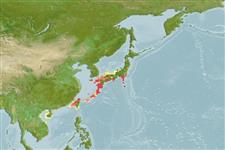
Northwest Pacific: Japan and Taiwan.
Größe / Gewicht / Alter
Geschlechtsreife: Lm ? range ? - ? cm
Max length : 3.6 cm SL Männchen/unbestimmt; (Ref. 84020); 3.6 cm SL (female)
Kurzbeschreibung
Bestimmungsschlüssel | Morphologie | Morphometrie
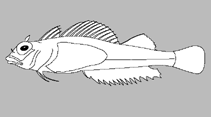
Rückenflossenstacheln (insgesamt) : 16; Rückenflossenweichstrahlen (insgesamt) : 9 - 11; Afterflossenstacheln: 1; Afterflossenweichstrahlen: 17 - 19. This species is distinguished by the following set of characters: 12-13 (rarely 14) spines on second dorsal-fin; 17-19 (rarely 20) anal-fin soft rays; 16-19 pored lateral-line scales; 17-19 notched lateral-line scales; 1-6 rows of small cycloid scales on boundary between abdomen and sides; simple, unbranched dermal flap of anterior nostril; simple dermal flap on orbit; prevomer with 1 teeth row; mandibular pore formula usually 4+1+4 (4-5+1+4-6); male with pale reddish brown body, female pale yellowish brown; shoulder girdle with 2 oblique white markings, upper one anterior to pectoral-fin base and lower one above pelvic-fin base; body with 8 dark saddle markings and a row of 5-6 small, ring-like white markings laterally; a blackish band with posterior white margin on caudal peduncle (Ref. 84020). Mandibular pore pattern 4+1+4 and D2 XIII (Ref. 79877).
Body shape (shape guide): elongated.
Known from rocky shores (Ref. 84020). Eggs are hemispherical and covered with numerous sticky threads that anchor them in the algae on the nesting sites (Ref. 240). Larvae are planktonic which occur primarily in shallow, nearshore waters (Ref. 94114).
Lebenszyklus und Paarungsverhalten
Geschlechtsreife | Fortpflanzung | Ablaichen | Eier | Fruchtbarkeit | Larven
Endo, H., E. Katayama, M. Miyake and K. Watase, 2010. New records of a triplefin, Enneapterygius leucopunctatus, from southern Japan (Perciformes: Tripterygiidae). pp. 9-16. H. Motomura and K. Matsuura (eds). Fishes of Yaku-shima Island. National Museum of Nature and Science, Tokyo, 10 March 2010. (Ref. 84020)
IUCN Rote Liste Status (Ref. 130435: Version 2025-2 (Global))
Bedrohung für Menschen
Harmless
Nutzung durch Menschen
Fischereien: nicht kommerziell
Tools
Zusatzinformationen
Download XML
Internet Quellen
Schätzungen auf der Grundlage von Modellen
Bevorzugte Temperatur (Ref.
123201): 19.1 - 26.6, mean 22.6 °C (based on 177 cells).
Phylogenetischer Diversitätsindex (Ref.
82804): PD
50 = 0.5000 [Uniqueness, from 0.5 = low to 2.0 = high].
Bayesian length-weight: a=0.00617 (0.00290 - 0.01310), b=3.04 (2.86 - 3.22), in cm total length, based on LWR estimates for this (Sub)family-body shape (Ref.
93245).
Trophische Ebene (Ref.
69278): 3.1 ±0.3 se; based on size and trophs of closest relatives
Widerstandsfähigkeit (Ref.
120179): hoch, Verdopplung der Population dauert weniger als 15 Monate. (Preliminary K or Fecundity.).
Anfälligkeit der Fischerei (Ref.
59153): Low vulnerability (10 of 100).
🛈