>
Cypriniformes (Carps) >
Balitoridae (River loaches)
Etymology: eddsi: Named for D.R. Edds, who collected the type series, in recognition of his contribution to the knowledge of the fish fauna of Nepal (Ref. 84034).
Eponymy: Dr David Ray Edds (d: 1954) is an ichthyologist and aquatic ecologist. [...] (Ref. 128868), visit book page.
Milieu: milieu / Klimaatzone / Diepte / verspreidingsgebied
Ecologie
; zoet water demersaal. Tropical; 29°N - 28°N, 81°E - 82°E
Asia: Nepal.
Grootte / Gewicht / Leeftijd
Maturiteit: Lm ? range ? - ? cm
Max length : 4.6 cm SL mannelijk / geslacht onbekend; (Ref. 84034)
Korte beschrijving
Determinatiesleutels | Morfologie | Morfometrie
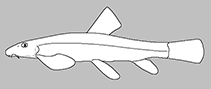
Distinguished from all congeners by its lower number of unbranched pectoral-fin rays (6-7 v. 8-12), by its shorter pelvic fins (12·8-14%LSv. 19-24) and by the absence of dark circular or irregular shaped dark blotches along the dorsal midline (v. presence of dark circular or irregular shaped dark blotches arranged in a longitudinal row along dorsal midline). Balitora eddsi is further distinguished from B. brucei by its posteriorly pointed (v. posteriorly rounded) median lobe between anterior rostral barbels and its pointed (v. rounded) snout, from B. brucei, B. burmanica, B. kwangsiensis, B. lancangjiangensis, B. meridionalis and B. nantingensis by its more posteriorly positioned dorsal fin (dorsal-fin origin posterior to pelvic-fin origin v. dorsal-fin origin opposite pelvic-fin origin in B. brucei, B. burmanica, B. lancangjiangensis and B. meridionalis or anterior to pelvic-fin origin in B. kwangsiensis and B. nantingensis), from B. burmanica, B. annamatica, B. meridionalis, B. mysorensis and B. nantingensis by its higher number of lateral-line scales (66-67 v. 62-65 in B. burmanica, 61-62 in B. annamatica, 62-64 in B. meridionalis, 64-65 in B. mysorensis, 59-64 in B. nantingensis) and from B. annamatica, B. meridionalis and B. mysorensis by its longer and more slender caudal peduncle (caudal peduncle length 22-23·2% LS, its depth 4·1-4·2 times its length v. caudal peduncle length 13-15% LS in B. annamatica, its depth 1·9-2·2 times its length; 14-16% LS in B. meridionalis, its depth 1·9-2·8 its length; caudal peduncle depth 1·9 times its length in B. mysorensis). It is further distinguished from B. longibarbata in having one barbel at each corner of the mouth (v. a pair of barbels at each corner of the mouth).
Body shape (shape guide): eel-like.
The species was collected during a rafting trip down the Gerwa River, but the precise collection sites of the type series cannot be pinpointed with any further accuracy. The rafting trip occurred between 1000 and 1700 hours, and collections were made with a cast-net
and 15 foot long straight seine (Ref. 84034).
Levenscyclus en paargedrag
Maturiteit | Voortplanting | Paaien | Eieren | Fecunditeit | Larven
Conway, K.W. and R.L. Mayden, 2010. Balitora eddsi, a new species of hillstream loach (Ostariophysi: Balitoridae) from Nepal. J. Fish Biol. 76(6):1466-1473. (Ref. 84034)
Status op de Rode Lijst van het IUCN (Ref. 130435: Version 2025-2 (Global))
Gevaar voor de mens
Harmless
Gebruik door de mens
Tools
Speciale rapporten
Download XML
Internetbronnen
Schattingen op basis van modellen
Fylogenetische diversiteitsindex (Ref.
82804): PD
50 = 0.5000 [Uniqueness, from 0.5 = low to 2.0 = high].
Bayesian length-weight: a=0.00214 (0.00085 - 0.00539), b=3.09 (2.87 - 3.31), in cm total length, based on LWR estimates for this (Sub)family-body shape (Ref.
93245).
Trofisch niveau (Ref.
69278): 2.6 ±0.2 se; based on size and trophs of closest relatives
Kwetsbaarheid van de visserij (Ref.
59153): Low vulnerability (10 of 100).
🛈