>
Acanthuriformes (Surgeonfishes) >
Pomacanthidae (Angelfishes)
Etymology: Chaetodontoplus: Greek, chaite = hair + Greek, odous = teeth + Greek, plous, ous, oo = crossing (Ref. 45335); poliourus: Named for its grey caudal fin.
More on authors: Randall & Rocha.
Entorno: milieu / zona climática / rango de profundidad / gama de distribución
Ecología
marino asociado a arrecife; rango de profundidad 1 - 20 m (Ref. 90102). Tropical
Distribución
Territorios | Áreas FAO | Ecosistemas | Ocurrencias, apariciones | Mapa de puntos | Introducciones | Faunafri
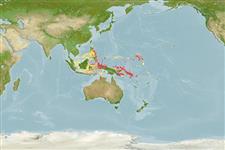
Western Pacific: Papua New Guinea, Solomon Islands, Palau and Indonesia.
Tamaño / Peso / Edad
Madurez: Lm ? range ? - ? cm
Max length : 8.6 cm SL macho / no sexado; (Ref. )
Descripción breve
Claves de identificación | Morfología | Morfometría
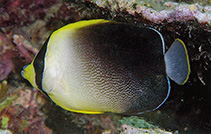
Espinas dorsales (total) : 12; Radios blandos dorsales (total) : 17; Espinas anales: 3; Radios blandos anales: 16 - 17; Vértebra: 24. This species is distinguished by the following characters: D XII,17 (rarely 16or 18); A III,16 or 17; pectoral rays 15-17 (usually 16); small scales, about 80 in longitudinal series; dorsal series of pored lateral line scales 29-35; gill rakers 4 + 12; supraneural bones 2; body depth 1.70-1.85 in SL; head length 3.15-3.3 in SL; fourth to sixth dorsal spines longest, 1.1-1.3 in HL. Preserved color head and anterior body pale yellowish grey to an approximate oblique demarcation connecting base of second to third dorsal spine to anus, gradually changing posteriorly in an intermediate zone containing pectoral fin to one of irregular longitudinal lines on dark brown; a dark brown bar from nape, broadening as it passes through eye, then curving and narrowing as it ends shortly before origin of pelvic fins; front of lips brown; dorsal and anal fins colored as adjacent body; caudal fin abruptly pale grey; paired fins pale yellowish. Color in life: dark brown posteriorly with white dots, which merge anteriorly to form narrow irregular white lines; dark brown of body progressively lighter anteriorly, becoming pale grey at demarcation, then gradually changing to pale yellow on head; ocular bar black, narrowly edged in bluish white; snout and chest yellow, the front lips blue which sometimes continue as a narrow triangle medially in front of snout; first 3-4 dorsal spines and membranes yellow, the rest of fin dark brown with rows of white dots paralleling rays on about basal 3/4 of fin; narrow white or blue margin on soft part of fin; anal fin similar, but not yellow anteriorly; caudal fin grey with a narrow yellow posterior border; pectoral fins pale grey; pelvic fins bright yellow (Ref. 82330).
Body shape (shape guide): short and / or deep.
Very close to Chaetodontoplus mesoleucus (Bloch, 1787) with different colors on pelvic, dorsal and caudal fins. The two species coexist in several islands of Indonesia (Ref. 82330). These islands include Lesser Sunda Islands. Molucca Islands, Halmahera, and Bird's Nest Peninsula of West Papua (Ref. 90102).
Ciclo vital y comportamiento de apareamiento
Madurez | Reproducción | Puesta | Huevos | Fecundidad | Larva
Randall, J.E. and L.A. Rocha, 2009. Chaetodontoplus poliourus, a new angelfish (Perciformes: Pomacanthidae) from the Tropical Western Pacific. The Raffles Bull. Zool. 57(2):511-520. (Ref. 82330)
Situación en la Lista Roja de la UICN (Ref. 130435: Version 2025-2 (Global))
Amenaza para el ser humano
Harmless
Usos humanos
Herramientas
Informes especiales
Descargar XML
Fuentes de Internet
Estimaciones basadas en modelos
Temperatura preferida (Referencia
123201): 28.8 - 29.3, mean 29 °C (based on 385 cells).
Índice de diversidad filogenética (Referencia
82804): PD
50 = 0.5000 [Uniqueness, from 0.5 = low to 2.0 = high].
Bayesian length-weight: a=0.03020 (0.01316 - 0.06929), b=2.89 (2.70 - 3.08), in cm total length, based on LWR estimates for this (Sub)family-body shape (Ref.
93245).
Vulnerabilidad pesquera (Ref.
59153): Low vulnerability (10 of 100).
🛈