Classificazione / Nomi
Nomi Comuni | Sinonimi | Catalog of Fishes(Genere, Specie) | ITIS | CoL | WoRMS | Cloffa
>
Siluriformes (Catfishes) >
Doradidae (Thorny catfishes) > Doradinae
Etymology: Leptodoras: Greek, leptos = thin + Greek, doras = skin (Ref. 45335); marki: Leptodoras marki is named in honor of Mark Henry Sabaj Pérez, for his dedicated service to the ichthyological community as Collection Manager of Fishes at the Illinois Natural History Survey (1995–2000) and at the Academy of Natural Sciences of Philadelphia (2000–present), and for encouraging the study of doradids as a co-principal investigator of the All Catfish Species Inventory.
Ambiente: milieu / zona climatica / distribuzione batimetrica / gamma di distribuzione
Ecologia
; acqua dolce benthopelagico. Tropical; 6°S - 8°S, 50°W - 52°W
South America: Brazil. Known from Rio Fresco basin, a tributary of Rio Xingu (Ref. 84244).
Dimensione / Peso / Età
Maturità: Lm ? range ? - ? cm
Max length : 9.3 cm SL maschio/sesso non determinato; (Ref. 84244)
Breve descrizione
Chiavi di identificazione | Morfologia | Morfometria
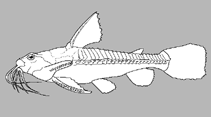
Leptodoras marki is distinguished from its congeners by having a large dark submarginal blotch on distal half of dorsal-fin spine and anteriormost dorsal-fin branched rays (vs. dorsal fin hyaline in L. acipenserinus, L. cataniai, L. linnelli, L. myersi, L. nelsoni, L. rogersae, or dorsal fin with basal third to half of dorsal-fin spine and dorsal-fin branched rays blackened, forming a triangular blotch tapered posteriorly in L. copei, L. oyakawai, L. praelongus, or dorsal fin with base of branched rays darkened in L. juruensis); lower labial extension of modified oral hood extending more posteriorly than upper labial extension (vs. upper labial extending posteriorly to lower labial extension in L. acipenserinus, L. cataniai, L. juruensis, L. myersi, L. nelsoni, L. rogersae, or upper and lower labial extensions finishing more or less even in L. hasemani, L. linnelli); relatively few midlateral scutes (34–37 vs. 37–46 per side in all congeners except in L. copei, L. oyakawai, L. praelongus); gas bladder moderately sized, not reduced (vs. reduced in all congeners, except in L. oyakawai); paired bony capsules on anteriormost vertebrae reduced to paired cup-like laminar ossifications separated by a triangular septum (vs. paired bony capsules longitudinally expanded, rounded, and more bulbous, not compressed anteriorly in all congeners, except in L. oyakawai); pair of small, swelling-like diverticula on each side of the anterior chamber of gas bladder (vs. gas bladder with smooth walls, without diverticula in L. oyakawai); a well-developed anterior nuchal plate and parieto-supraoccipital not contacting middle nuchal plate (vs. anterior nuchal plate reduced, permitting contact between parieto-supraoccipital and middle nuchal plate in most specimens of L. praelongus); and nuchal foramina present (vs. absent in medium to large specimens of L. copei, L. hasemani, L. praelongus) (Ref. 84244).
Body shape (shape guide): elongated; Cross section: compressed.
Ciclo vitale e comportamento di accoppiamento
Maturità | Riproduzione | Deposizione | Uova | Fecondità | Larve
Birindelli, J.L.O. and L.M. Sousa, 2010. New Species of the Thorny Catfish Genus Leptodoras (Siluriformes: Doradidae) from Rio Fresco, Xingu Basin, Brazil. Copeia 2010(2):292-299. (Ref. 84244)
Stato della Lista Rossa IUCN (Ref. 130435: Version 2025-2 (Global))
Minaccia per l'uomo
Harmless
Usi umani
Strumenti
Rapporti speciali
Scarica XML
Fonti Internet
Stime basate su modelli
Indice di diversità filogenetica (Fonte Biblio.
82804): PD
50 = 0.5002 [Uniqueness, from 0.5 = low to 2.0 = high].
Bayesian length-weight: a=0.01230 (0.00587 - 0.02579), b=2.96 (2.78 - 3.14), in cm total length, based on LWR estimates for this (Sub)family-body shape (Ref.
93245).
Livello trofico (Fonte Biblio.
69278): 2.9 ±0.4 se; based on size and trophs of closest relatives
Vulnerabilità della pesca (Ref.
59153): Low vulnerability (10 of 100).
🛈