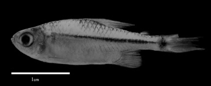
Classificazione / Nomi
Nomi Comuni | Sinonimi | Catalog of Fishes(Genere, Specie) | ITIS | CoL | WoRMS | Cloffa
>
Characiformes (Characins) >
Acestrorhamphidae (American tetras) > Hyphessobryconinae
Etymology: Hyphessobrycon: Greek, hyphesson, -on, -on = a little smaller + Greek, bryko = to bite (Ref. 45335); amaronensis: Named for Caño Amaron, the type locality.
Ambiente: milieu / zona climatica / distribuzione batimetrica / gamma di distribuzione
Ecologia
; acqua dolce pelagico. Tropical
South America: Colombia.
Dimensione / Peso / Età
Maturità: Lm ? range ? - ? cm
Max length : 2.7 cm SL maschio/sesso non determinato; (Ref. 84248)
Breve descrizione
Chiavi di identificazione | Morfologia | Morfometria
Raggi dorsali molli (totale) : 8; Raggi anali molli: 14 - 16; Vertebre: 31 - 33. This species is distinguished from other species of the H. heterorhabdus
group by the following characters: dorsal-fin rays 3 simple, 8 branched (vs. 2 simple and 9 branched rays, except in H. oritoensis, H. notidanus and H. ocasoensis that have iii, 8; pored lateral line scales 3-5 (vs. 7-23); scales in the lateral series 27-28 (vs. 29-35, except in H. proteus which has 27-30); 3 scales from lateral series to anal fin (vs. 4-7); anal-fin rays 2 simple (vs. iii-iv) and 14-16 branched (vs. 18-27) except in H. diancistrus
with 14-16 branched anal-fin rays); length of the caudal peduncle, mean 26.75% SL (vs. 8.84-15.89% SL); upper jaw length, mean 15.66% SL (vs. 22.70-30.51%); males with a convex modification at base of anal fin in the anterior anal-fin rays (vs. no modification) (Ref. 84248).
Body shape (shape guide): fusiform / normal.
Found over organic detritus and decomposing vegetation, apparent water color was brown to black, low dissolved oxygen (0.42-0.75 mg/l), as was conductivity (42-43 μs) and oxygen saturation (5.3-10 %), slightly acidic pH (6.0-6.2). Five stomachs of cleared and stained specimens indicate a diet mostly composed of algae, Clorophyta, Vlothix (47.72% N, 22.72%V); also present are Cladocera, Alonella (20.45% N, 13.63% V); Clorophyta, Spirogyra (17.04%N, 9.09%V); insect parts (9.09%N, 18.18%V), dipteran larvae, Tabaridae (5.47% N, 5.47% V); Ephemeroptera, Oligoneuridae (1.13%N, 4.54%V) and unidentified digested material (27.27%V) (Ref. 84248)..
Ciclo vitale e comportamento di accoppiamento
Maturità | Riproduzione | Deposizione | Uova | Fecondità | Larve
García-Alzate, C.A., C. Román-Valencia and D.C. Taphorn, 2008. Two new species of Hyphessobrycon (Pisces: Characiformes: Characidae) from Putumayo River, with keys to the Colombian Hyphessobrycon heterorhabdus-group species. Brenesia 70:33-46. (Ref. 84248)
Stato della Lista Rossa IUCN (Ref. 130435: Version 2025-2 (Global))
Minaccia per l'uomo
Harmless
Usi umani
Strumenti
Rapporti speciali
Scarica XML
Fonti Internet
Stime basate su modelli
Indice di diversità filogenetica (Fonte Biblio.
82804): PD
50 = 0.5000 [Uniqueness, from 0.5 = low to 2.0 = high].
Bayesian length-weight: a=0.01202 (0.00479 - 0.03019), b=3.09 (2.90 - 3.28), in cm total length, based on LWR estimates for this Genus-body shape (Ref.
93245).
Livello trofico (Fonte Biblio.
69278): 3.0 ±0.3 se; based on size and trophs of closest relatives
Vulnerabilità della pesca (Ref.
59153): Low vulnerability (10 of 100).
🛈