Klassifizierung / Names
Namen | Synonyme | Catalog of Fishes(Gattung, Arten) | ITIS | CoL | WoRMS | Cloffa
>
Beloniformes (Needle fishes) >
Adrianichthyidae (Ricefishes) > Oryziinae
Etymology: Oryzias: Greek, oryza = rice; because of the habitat used by this fish (Ref. 45335).
Eponymy: Dr Daisy Wowor (d: 1956) is an evolutionary biologist and systematic carcinologist. [...] (Ref. 128868), visit book page.
Umwelt: Milieu / Klimazone / Tiefenbereich / Verbreitungsgebiet
Ökologie
; süßwasser pelagisch; pH range: 6.0 - 7.0. Tropical; 5°S - 6°S, 122°E - 123°E
Asia: Indonesia. The single known collection of O. woworae was from the type locality Sulawesi Tenggara, Muna Island, Regency of Muna, District Parigi, Village Wakumoro, Mata air Fotuno (Ref. 84259).
Größe / Gewicht / Alter
Geschlechtsreife: Lm ? range ? - ? cm
Max length : 2.8 cm SL Männchen/unbestimmt; (Ref. 84259)
Kurzbeschreibung
Bestimmungsschlüssel | Morphologie | Morphometrie
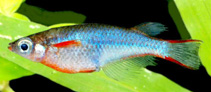
Oryzias woworae is distinguished from all other ricefishes by an autapomorphic color pattern of both sexes in life: the ventral surface of head and body anterior to pelvic fins, dorsal portion of pectoral fins, dorsal-fin base, posterior portion of anal-fin base, caudal peduncle, and dorsal and ventral portions of caudal fin are brilliant red; the midlateral scales from just posterior to the eye to the caudal-fin base and the body scales anterior to the anal fin and below midlateral scales are steel blue. The operculum and base of the pectoral fin are silvery. Oryzias woworae has a truncate, rather than lunate or emarginate, caudal fin that distinguishes it from the large, pelagic Sulawesi ricefish in the genus Adrianichthys and five species of Oryzias: O. bonneorum, O. nebulosus, O. nigrimas, O. orthognathus, and O. sarasinorum. Oryzias woworae is readily distinguished from other Oryzias with a truncate caudal fin by an hour-glass shaped, rather than rounded, ossified portion of the mesethmoid with no cartilage on its midlateral margins, like the ethmoid of some of the larger, pelagic Sulawesi ricefishes (Ref. 84259).
Body shape (shape guide): elongated.
Lebenszyklus und Paarungsverhalten
Geschlechtsreife | Fortpflanzung | Ablaichen | Eier | Fruchtbarkeit | Larven
Parenti, L.R. and R.K. Hadiaty, 2010. A new, remarkably colorful, small ricefish of the genus Oryzias (Beloniformes, Adrianichthyidae) from Sulawesi, Indonesia. Copeia 2010(2):268-273. (Ref. 84259)
IUCN Rote Liste Status (Ref. 130435: Version 2025-2 (Global))
Bedrohung für Menschen
Harmless
Nutzung durch Menschen
Fischereien: nicht kommerziell
Tools
Zusatzinformationen
Download XML
Internet Quellen
Schätzungen auf der Grundlage von Modellen
Phylogenetischer Diversitätsindex (Ref.
82804): PD
50 = 0.5000 [Uniqueness, from 0.5 = low to 2.0 = high].
Bayesian length-weight: a=0.00479 (0.00190 - 0.01207), b=3.13 (2.91 - 3.35), in cm total length, based on LWR estimates for this (Sub)family-body shape (Ref.
93245).
Trophische Ebene (Ref.
69278): 3.2 ±0.4 se; based on size and trophs of closest relatives
Anfälligkeit der Fischerei (Ref.
59153): Low vulnerability (10 of 100).
🛈