Taxonomic Remarks
Siimilar species:Ostracion immaculatum (Ref. 3141).
Environnement : milieu / zone climatique / profondeur / gamme de distribution
Écologie
marin récifal; profondeur 1 - 280 m (Ref. 50734), usually 1 - 50 m (Ref. 9806). Tropical; 30°N - 32°S
Indo-Pacific: Persian Gulf (Ref.80050), Red Sea and East Africa (Ref. 3141) to the Hawaiian and Tuamoto islands, north to Ryukyu Islands, south to Lord Howe Island.
The Red Sea population differs slightly in coloration and has been known as Ostracion argus.
Closely related to Ostracion immaculatum from southern Japan. Southeast Atlantic: south coast of South Africa (Ref. 3141).
Taille / Poids / Âge
Maturité: Lm ? range ? - ? cm
Max length : 45.0 cm TL mâle / non sexé; (Ref. 9806)
Description synthétique
Clés d'identification | Morphologie | Morphométrie
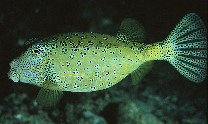
Épines dorsales (Total) : 0; Rayons mous dorsaux (Total) : 8 - 9; Épines anales: 0; Rayons mous anaux: 9. Caudal fin rays 10. Juveniles bright yellow with black spots; the spots decrease proportionately and the bright yellow becomes a dirty mustard with growth; large adults become bluish with yellowish seams between the plates.
Body shape (shape guide): short and / or deep.
Inhabit lagoon and semi-sheltered seaward reefs. Juveniles often among Acropora corals (Ref. 9710). Benthopelagic (Ref. 58302). Solitary (Ref. 5503). Juveniles expatriating to subtropical zone from the pelagic larval stage. Small juveniles secretive in narrow crevices (Ref. 48637). Feed primarily on algae with a compliment of microorganisms, invertebrates, mollusks, sponges (Ref. 5503), sand dwelling polychaetes, crustaceans, foraminiferans, and fishes (Ref. 37816).
Cycle de vie et comportement reproducteur
Maturité | Reproduction | Frai | Œufs | Fécondité | Larves
Occurs in harems consisting of single males and 2-4 females (Ref. 37175).
Myers, R.F., 1991. Micronesian reef fishes. Second Ed. Coral Graphics, Barrigada, Guam. 298 p. (Ref. 1602)
Statut dans la liste rouge de l'IUCN (Ref. 130435: Version 2025-2 (Global))
Menace pour l'homme
Harmless
Utilisations par l'homme
Pêcheries: intérêt commercial mineur; Aquarium: Commercial
Outils
Articles particuliers
Télécharger en XML
Sources Internet
Estimations basées sur des modèles
Température préférée (Réf.
123201): 24.5 - 29, mean 28 °C (based on 2528 cells).
Indice de diversité phylogénétique (Réf.
82804): PD
50 = 0.5020 [Uniqueness, from 0.5 = low to 2.0 = high].
Bayesian length-weight: a=0.05495 (0.03484 - 0.08669), b=2.75 (2.61 - 2.89), in cm total length, based on LWR estimates for this species & (Sub)family-body (Ref.
93245).
Niveau trophique (Réf.
69278): 3.3 ±0.35 se; based on food items.
Résilience (Réf.
120179): Haut, temps minimum de doublement de population inférieur à 15 mois (Fec assumed to be > 10,000).
Vulnérabilité de la pêche (Ref.
59153): Low to moderate vulnerability (35 of 100).
🛈
Nutriments (Ref.
124155): Calcium = 33.1 [14.1, 82.4] mg/100g; Iron = 0.564 [0.295, 1.271] mg/100g; Protein = 18.3 [16.1, 20.5] %; Omega3 = 0.129 [0.065, 0.249] g/100g; Selenium = 54.8 [27.5, 115.5] μg/100g; VitaminA = 40.7 [11.0, 155.1] μg/100g; Zinc = 0.908 [0.606, 1.357] mg/100g (wet weight);